Wednesday, December 20, 2006

Video Review - part 1


From time to time I’ll be reviewing videos/dvd’s relating to various subjects discussed in this blog. The material will tend to be of an instructional or documentary nature, although once in a while I’ll throw in something of a more mainstream genre if I feel it has something to offer beyond just entertainment value.

The first review is something I’ve received a lot of emails about. This is basically a reprint from our private Pekiti Tirsia forum for the benefit of those who do not have access to that forum.

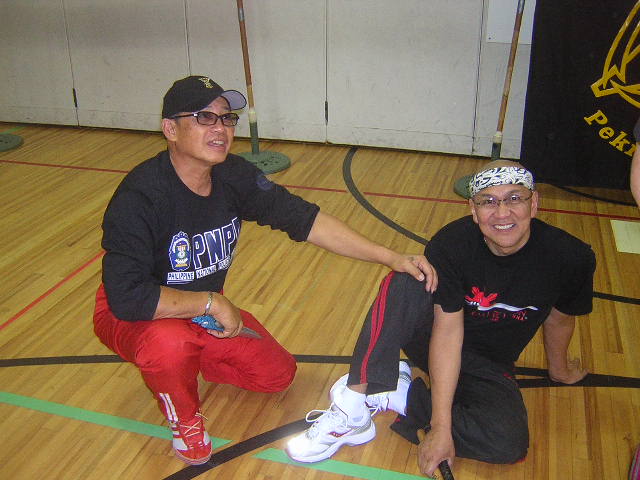
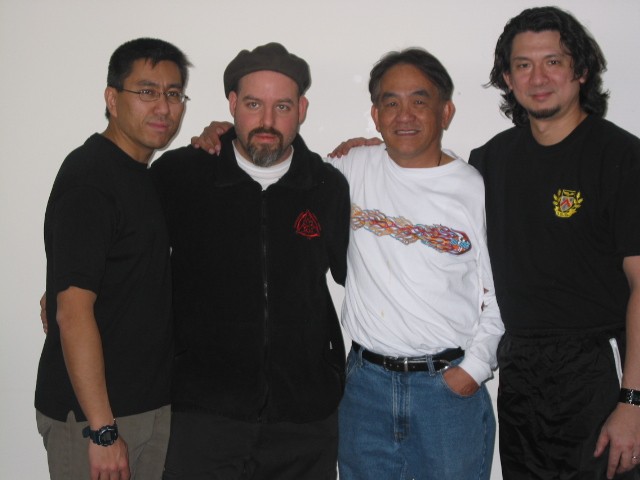
The ‘Combatants’ dvd is a Compare-the-Styles piece featuring the following teachers:

Bill Kipp - FAST Defense
Michael Casey - Wing Tzun
Moni Aizik - Commando Krav Maga
Leo T. Gaje - Pekiti Tirsia Kali

For a detailed description of the content, please visit this website:

http://www.comparestyles.com/

which offers the following synopsis:

“The Combatant DVD contains an objective look at 4 different approaches to self defense by 4 Masters of the martial arts. If you are interested learning the martial arts or self defense but don't know which art to study then buy Combatant Extreme Self Defense.

If you are an experienced martial artist, you'll want to see how each art handles the same situations differently and WHY. These arts are very popular arts for cross training and are known as being focused on the street.

Four Masters of some most street effective martial arts show you their different theories and techniques on defending yourself from common attacks.”


Now keeping in mind that most of the emails I’ve received are from folks who have already seen the video, and want to know my opinion of it, here it is:

I was not particularly impressed by the Wing Tzun and "Fast Defense" presentations.

The only thing notable in my opinion about Commando Krav Maga is that whereas most of the Krav Maga that I've seen looks like bad 3d-rate Muay Thai, this stuff looks like bad 3d rate Japanese jujutsu. I'd rather learn those exact same moves the correct way from a good Jujutsu teacher. But I did indeed get the sense that the teacher could handle himself in a fight.

I have mixed feelings on Tuhon Gaje's presentation. The thing I've noticed about Tuhon and "demos" like this is that he's too self-conscious in front of the camera. When he does a combination where he has to explain the moves in English- like in the first part of the dvd - he's not only thinking about what he's doing but also thinking about how to explain what he's doing, and the technique gets lost in that process. His later presentation where he just flows and lets loose on Tim Waid is a lot cleaner and more fluid.

On the positive side: It’s a rare and wonderful thing to see teachers of different backgrounds collaborating on a project. I also think this is a great concept for a dvd, and I wholly respect the efforts of everyone involved in the production.

I'm sure the next offering will be a lot better.

Thursday, December 14, 2006

Ode Remo


Visiting an "Old Friend" in Ode Remo

Yoruba hunters are an "interesting" bunch. The only time I have seen them in the village has been during the early, early morning hours when I accompanied Araba Adesanya's daughter to get water from the communal well about an hours walk from Ogunti Compound.

The Hunters...you can see one coming a mile away, and they carry themselves as if they would just as soon tear your head off as say 'Good Morning'. On the last trip we were fortunate enough to be able to spend some time with them under almost normal conditions on the outskirts of town. It was a night that none of us will ever forget.

"Gba mi, gba mi" ko yeegun
"Ibi ogun le mi de ree" ko yode
"Gba mi, gba mi" ko yoosa
"Ibi eran le mi de ree" ko yode

It is a paradox for Ancestral Masqueraders to call for help from human beings
For a Hunter to say "This is how far War drove me" is unbefitting
It is a paradox for a Deity to call for help from a human being
For a Hunter to say "This is how far the Prey drove me" is unbefitting

Wednesday, December 06, 2006

The Most Fun Demo Ever


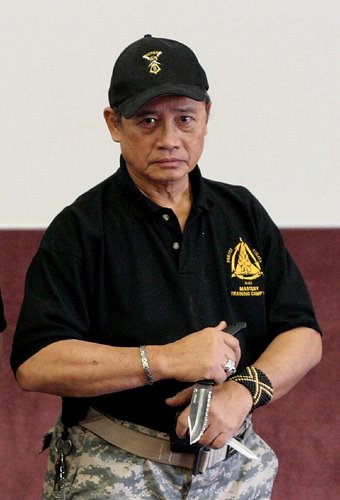
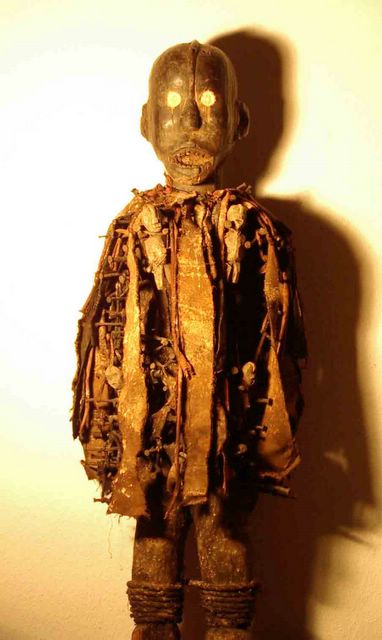
Last weekend we gave a demo at a huge banquet hall in St. Clair Shores. I would love to post some pictures here, but my crappy digital camera malfunctioned* Being that there are no pics from our demo, I decided instead to post this cool shot of Tuhon Gaje in "High Priest" garb (the Discovery Channel is filming a documentary on FMA in the Philippines which will feature Pekiti Tirsia prominently - this photo was taken during that filming).

Anyway, for this particular demo Kapatid Damon Mitchell was arguably the Star of the show, if not the entire night. After nearly killing us all with his homicidal driving on I-94, then antagonizing the waitstaff and house security to the point of a near confrontation, he performed a breathtaking sayaw with a single bolo, followed by Contradas and an excellent rendition of Kali De Leon's "Tic-Bang" double stick drill - which turned out to be a real crowd pleaser.

Congratulations Damon. And as always, thanks for keeping it real.


* Its Christmas/Hanukah/Kwanzaa time...a new digital camera is on my list!

Saturday, November 04, 2006

Pekiti Tirsia in the Military


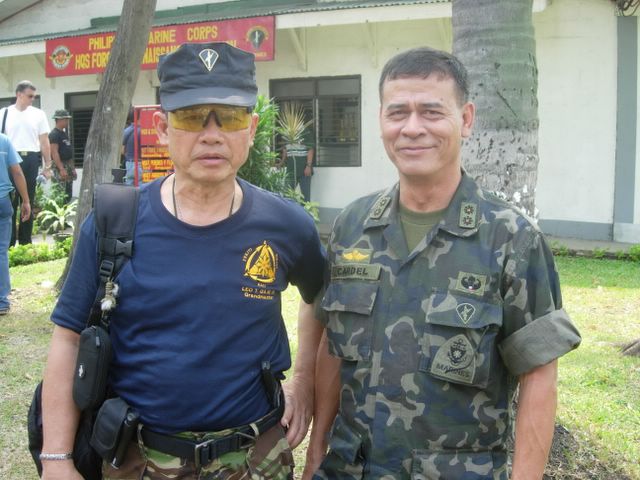
Supreme Grand Tuhon Leo T. Gaje Jr. and Col.Cardell of the Philippine Marines


A more detailed article on Pekiti Tirsia’s relationship with the U.S. and Philippine Military is presented in the article below from www.pt-go.com Experts from the following branches of the Armed Forces agree that Pekiti Tirsia is the best option for personal and national security!

* United States Marine Corp.

* Philippine Force Recon Marines

* Special Action Force (SAF) Commandos of the Philippine National Police

* Crisis Response Group (CRG) Counter-Terrorism Task Force of the Philippines

1998 was a historical landmark year for the Pekiti-Tirsia system in the Philippines. In the history of the Armed Forces of the Philippines, Pekiti-Tirsia was to be the first authentic Filipino combat system and martial art adopted as official warfighting doctrine. For three years previous, the Force Reconnaissance Battalion of the Philippine Marine Corps researched the different Filipino combat systems/martial arts being practiced in the Philippines to specifically find the knowledge and essence of Bladed weapons combat. The marines of the Force Recon Battalion completed several combat skills courses and interviewed numerous instructors, but found none that taught combat with the live blade and that could teach a system to special operations forces applicable to their operational environment and requirements. Combat marines and soldiers are armed with an array of edged weapons including the bayonet, bolo, entrenching tool, fighting knife, and the multitude of improvised weapons found on the battlefield. As the recognized elite of the elite, the Force Recon Marines sought to set the standard for skill and instruction in close quarters combat. The battalion commanding officer, Major Natalio C. Ecarma, met with Mataas na Guro Tim Waid who had been residing in the Philippines and training with Grand Tuhon Gaje since 1993. As the Director of SURVIVAL EDGE SYSTEMS / Pekiti-Tirsia Tactical Training Institute, and himself a former marine, Guro Waid introduced the unit to the history, training methodologies, and effectiveness of the combat bladefighting system of Pekiti-Tirsia Kali. Guro Waid detailed the unparalleled, international professional recognition that Grand Tuhon Leo T. Gaje had brought to the field of military and law enforcement tactical training and demonstrated the use and employment of combat edged weaponry carried by operators on special operations missions. Guro Waid conducted an intensive six-month instructor’s candidate course in the Military Edged-Impact Weapon System for Close Quarters Combat/CQC graduating thirty (30) students in June of 1998.

The Commandant, then Major General Ponciano s. Millena, recognized the Pekiti-Tirsia system as the official Close Quarters Combat/CQC doctrine of the Philippine Marine Corps. Grand Tuhon Gaje and Guro Waid presented a framed Ginunting / Combat Bolo to General Millena forging the brotherhood of Pekiti-Tirsia and the Philippine Marines.

The Force Recon Marines have reinstituted and revitalized the historical use of authentic Filipino Bladefighting technology within the Armed Forces of the Philippines (AFP). Today, they are recognized as the leaders and subject matter experts (SME) in the use of Edged-Impact Weapon Strategy and Tactics within the AFP and now train all foreign special operations forces and ground force military units conducting joint training exercises and combat operations against insurgents and terrorists groups in the Philippines. Since 1998 they have proven the superiority of the Pekiti-Tirsia system against other military close quarter combative methods including the US Marine Corps Martial Art Program (MCMAP), SCARS method of US Navy SEALS, and the LINE method of US Army Special Forces. As in yesteryear when the Filipino instructed famous US military units of WWII including the Marine Raiders, Army Alamo Scouts, and led a successful guerrilla warfare campaign against the Japanese invaders by battalions armed with the Bolo, the Filipino fighting man is again recognized as the military Master of the Blade.

The Heritage of the Past and the Legacy of the Future

Article first appeared in the November 1998 issue of Citemar6. Official publication of the Philippine Marine Corps.

In this year of the Republic of the Philippines National Centennial Celebration, 1998, the Armed Forces of the Philippines (AFP) reclaims it true martial heritage with the Philippine Marine Corps Force Reconnaissance Battalion designation as the modern BOLO BATTALION. The Filipino Bolo has been the trademark combat weapon for generations of Filipino warriors and heroes from Datu Lapu Lapu to the founding fathers of the Katipunan and now of the Force Recon Marines. Today, the Force Reconnaissance Battalion is the only unit in the Armed Forces of the Philippines that trains, equips, and operates utilizing the traditional combat weapons, tactics, and skills of Kali. Kali, the true and authentic martial art of the Filipino is a systematic art of combat bladefighting based on the science of strategy and tactics.

The chronicles of Philippine history have recorded the victories of the Filipino Fighting Man in the defense of freedom, independence and democracy. Victories achieved by the use of the weapons and tactics of Kali. Kali prevailed against the finest European steel when Datu Lapu Lapu, the first Filipino hero, felled the famed Spanish conquistador Ferdinand Magellan in 1521. The Filipino Bolo was feared throughout the history of the Spanish occupation and the art of Kali brought many regional victories in the revolts against Spanish subjugation. Generals Artemio Ricarte, Gregorio Del Pilar, Antonio Luna, and other heroes of the revolution against Spain lead their troops to battle with Bolo in hand. The Bolo of Andres Bonifacio, hero of the Katipunan, symbolizes that gallant struggle that lead to the declaration of the first Philippine Republic. The American era brought respect for the fighting tenacity of the Filipino in such great measure that it influenced the adoption of the .45 Caliber automatic pistol for the U.S. Armed Forces. During World War II the American military recognized the superiority of Kali for close quarters combat. In 1942 the United States Marine Corps enlisted Filipinos to teach combat bladefighting with the knife, bayonet, and other hand-to-hand combat skills to the elite Marine Raider Battalions that spearheaded the war against the Japanese in the central Pacific. Most significantly, the First (1st) Filipino Regiment of the US Army became recognized as the original BOLO BATTALION. This unit, along with others such as the Philippine Scouts and other guerrilla units established the modern military legacy of Filipino Kali during the liberation of the Philippines when they fought blade to blade and blade to rifle and defeated the finest units of the Japanese Imperial Armed Forces armed and trained in the art of the Samurai.

From this heritage of the past the Marines of the Force Reconnaissance Battalion continue the Kali legacy of the future. The battalion, under the command of Major Natalio C. Ecarma III officially adopted the Pekiti-Tirsia Kali system as the unit’s formal doctrine for close quarters combat. Approved by the Commandant of the Philippine Marine Corps, Major General Ponciano S. Millena, the Pekiti-Tirsia Military EDGED-IMPACT WEAPON SYSTEM marks the first time in more than fifty years that the indigenous fighting art of Kali has been formulated for modern combat and officially recognized as tactical warfighting doctrine.

The Pekiti-Tirsia Military EDGED-IMPACT WEAPON SYSTEM is a combative skills program in Close Quarters Combat (CQC) tactical doctrine specifically formulated for military special operation forces. This system provides the operator complete strategies, tactics and skills for the use of combat weaponry in the entire operational continuum of modern combat from high intensity conventional war through the full spectrum of unconventional warfare.

The Military EDGED-IMPACT WEAPON SYSTEM/CQC parallels military combat doctrine to locate, close with and destroy the enemy by fire (Edged-Impact weaponry offensive and counter-offensive strikes) and maneuver (footwork and mobility) or repel the enemy’s assault by fire and close combat.

The Military EDGED-IMPACT WEAPON SYSTEM is comprised of:

1. Combat Bolo /CQB/ Close Quarters Bolo

2. Combat Knife /CQK/ Close Quarters Knifefighting

3. Combat Empty-Hands /CQE/ Close Quarters Empty-Hands

4. Combat Bayonet /CQB/ Close Quarters Bayonet

5. Tactical Weapons Disarming /CQD/ Close Quarters Disarming

6. Tactical Weapons Retention /CQR/ Close Quarters Retention

Trained in this complete system of Close Quarters Combat/CQC and armed with the Combat Bolo, the Force Reconnaissance Battalion leads the Special Operations Forces of the Armed Forces of the Philippines in tactical operational capabilities. Tasked with the missions of conducting air, ground, and amphibious reconnaissance for the three Marine Brigades and Regional Commanders as well as direct action operations such as raids, counter-terrorism, and hostage rescue, all Force Reconnaissance Marines are qualified combat parachutists and divers and are graduates of the Force Reconnaissance Qualification Course, Army Special Forces Qualification Course, or the Scout Ranger School.

Presently, the Battalion is composed of a Headquarters and Service Company and three (3) Force Reconnaissance Companies, the 61st, 62nd, and 63rd. Each company is composed of three (3) recon platoons and one (1) sniper platoon. The battalion is headquartered at Marine Barracks, Naval Station, Fort Bonifacio in Metro Manila, where the H&S Company and two recon companies are stationed. Each company is deployed on a rotational basis to Cotabato City, Mindanao in support of the Second (2nd) Marine Brigade. The Philippine Marine Corps maintains the majority of their forces in Mindanao and the Sulu Sea due to their continued victories against the numerous enemy forces and organized criminal elements that remain active in this historically war torn region.

Today, the Marines of the Force Reconnaissance Battalion enter the arena of warfare trained in the strategy and tactics of Kali and armed with the Combat Bolo, the symbol of victory, heroism, and excellence of the Filipino Fighting Man.

Saturday, October 28, 2006

Arere, Arere'ooooo!


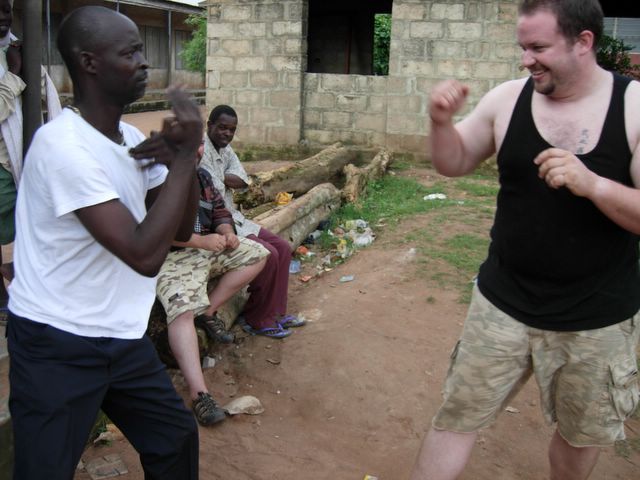
Ogun Fumito vs. Abiodun Ogunleye -
Jakadi Match Ode Remo, Ogun State 2006
(in the background is Jeff Davidson and Oluwasina Kuti)

Ogunda-Wonrin!
Ija ti ngo jayi ki'mi niyi-sii
Ajagbuye niti ekun
Ajagbuye niti Aara
Ogunda!
iwo lo nda won ni'jakadi lojogbogbo nilekile
Ija ti ngo ja ki'mi niyi-sii, Ajagbuyi

Let the Fight I will Fight be to My Honor
Victory After the Fight Belongs to the Lion
Vitory After the Fight Belongs to Aara
Like Ogunda,
All Day, You Hurled Them Down Everywhere
Let the Fight I will Fight be to My Honor

Odu'fa 152:1
translated by Jeff Davidson

Sunday, October 08, 2006

Pistol CQB Seminar - Comes Off with a Bang!


A Blank Canvas

I am very happy to report that the Pistol CQB seminar was an outstanding learning experience for all who attended.

Cpl. Ungyo presented a concise, challenging and very engaging (pardon the pun) class on the essentials of drawing, moving, target acquisition, malfunction drills, legal considerations, and just about everything else relevant to a concerned citizen facing down multiple aggressors with his pistol in his home, or on the street. After laying a solid foundation in the basics, we moved on with confidence to some very realistic scenario training, dealing with the tactics necessary to survive such volatile situations as armed robberies, home invasions and car jackings (this becoming somewhat of a sport in our inner city these days.)

I have always stressed the point that seminar material is only as good as the person teaching it. I have attended quite a few tactical shooting classes, and in some ways they are like any other martial arts seminar - meaning there is usually a high bullshit factor. In a typical martial arts seminar, the bullshit factor is usually found in the material itself ie. unrealistic techniques/tactics being taught by someone who has obviously never applied them in real life (in a T’ai Chi seminar this might not be an issue.) In a tactical shooting class, the bullshit factor is quite often the instructor. On the positive side, since most CQB instructors are seasoned law enforcement or military folks, they’ve actually “been there and done that” so there is a certain level of credibility when they teach. On the negative, even the guys who are not all macho Rambo types with war stories are often so very dogmatic in their approach that whatever does not fit into their rigid mentality is automatically discounted. I’ve even seen this in students when Tuhon Gaje has done his law enforcement seminars. When Tuhon tries to show how an officer can think outside the box with regard to his primary weapon, some of them just shut down.

Ungyo however, takes a very Tuhon-esque artistic approach to pistolcraft. He has a rock-solid, unquestionable understanding of the fundamentals, and can clearly communicate where and when there is room for personal interpretation. His own informed innovations seamlessly compliment the playbook, and clearly demonstrate how one can formulate a personal style of gun-fighting based on body mechanics and inter-personal dynamics, just as can be accomplished with edged and impact weapons. And as far as credibility goes, Ungyo has been there and done it. If there was ever a CQB class taught by instructor that could be called a Pekiti Tirsia Gun Seminar - this was it. It was a proud moment for me as well to be able to learn from someone who is usually my student. Truth be told, I have probably learned as much from him as he has from me over the years.

Now for a final word...

Pekiti Tirsia is always far, far ahead of the proverbial curve. Tuhon Gaje was teaching gun techniques to cops and the military before most of the MA community has ever even seen a knife drill. And today most of the foremost “knife experts” are teaching nothing more than sloppy re-hashes of Pekiti knife work from the 1970's. I predict that soon, we will see these same buffoons trying to fake their way through tactical shooting seminars by copying us. What will we be doing then? Difficult to say.

Maybe lasers.

Thursday, September 28, 2006

Pistol CQB Seminar


The long-awaited pistol Close Quarter Battle (CQB) seminar will be held on Sunday, October 8th. Please call or email for details on location and time.

Here are some updates:

- We will meet at the training hall at 10:45am on Sunday and caravan to the location of the seminar.

- Equipment needed:

* Airsoft pistol and holster (CCW holders may bring their unloaded carry pistol.)
* Eye Protection
* Extra t-shirt or bandana
* Wear your street clothes

Thursday, September 07, 2006

Band of Brothers (and Uncle)


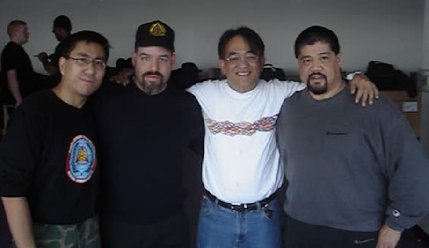
Here's a photo I just received from our 'Superbowl of Pekiti Tirsia' seminar a few months ago. From left: Ka Jay Saludo; Jeff Davidson; Tito Jun Saludo; Kuya Jamal Hakim Abdullah.

Monday, September 04, 2006

First Tekpi Instructors in the U.S.


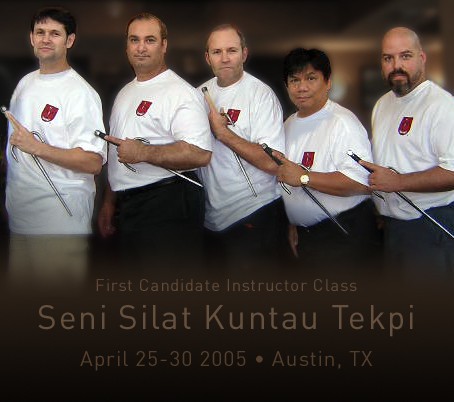
The First (and arguably the Best)

From left: Robert Slomkowski; Omar Hakim; Steve Slomkowski; Ricky Rillera; Jeff Davidson

Friday, September 01, 2006

Silat Melayu on the Move


Cikgu Mohd Nadzrin Wahab

For an outsider coming to Silat Kuntau Tekpi (or any Silat Melayu) it is not sufficient merely to learn the physical techniques of buah, tapak, kuncian, pukulan, etc. In order to truly grasp where the Art “is coming from” both historically and conceptually, one must endeavor to understand the culture which spawned it. For one who is so far removed from the Source - namely Malaysia - this is can be a daunting and often frustrating task.

Without a doubt, the greatest blessing on this journey into the hermetic world of Silat Melayu has been to make the acquaintance of a generous and enthusiastic teacher, practitioner, and eminent scholar of Silat Melayu named Mohd Nadzrin Wahab, known to many as Saiful Azraq. Any foreigner who has done even the most cursory research into Malaysian martial arts from the available resources in English knows this young man - primarily because Nadzrin is personally responsible for translating and making the information available to us!

It is no cliche to say that this young man is a veritable encyclopedia of information on the history, customs, traditions, lineages, masters, people, places, events, milestones and just about anything else significant to Silat. Luckily for us, he is a painstaking and patient guide. If by chance he doesn’t have the answers...he knows the folks that do.

I invite you to his blog: http://silatmelayu.blog.com/

Tell him ‘JD Tekpi’ sent you!

Monday, August 28, 2006

The Knife's Milonga (dedicated to Ungyo)


It came to me at Pehuajo
from some generous hands.
It is better not to know
the return of Rosas’ bands.
On the leather and wood no mark
of rood lies on its haft.
With dreams tiger dark
the steel dreams its tiger craft

The knife dreams of a hand
to deliver it from oblivion.
But all depends on what the man
with the hand decides.

The Pehuajo dagger owes
not a single death.

For a tremendous
fate the forger forged its breadth.
Beholding it I can only forsee
a future filled with daggers
as well as swords and sabers
and other deadly forms
so many that the world draws
near the point of death,
so many that death knows
not which to choose.

Dream your easy dream
in this tranquil state
Be not impatient, blade,
Rosas returns to his estate.

- Jorge Luis Borges

Friday, July 28, 2006

Pekiti Tirsia in the Bible(!)

Remember the 'Bible Code' that was all the rage before the 'DaVinci Code' made the scene? A friend of mine has a Bible Code software program where you type in a word or phrase, and it gives the chapter in scripture (parasha) from where your term or phrase is said to "emanate". This has to do with Kabbalistic concepts such as Gematria and Tzeruf which are beyond the scope of this blog to explain. Well, we typed in the phrase PEKITI TIRSIA and what we got back is the story of Pinhas ben Yair, summarized below. Maybe there's something to this after all...

The story of Pinhas actually began at the end of the previous Parashah. While the Israelites were encamped at Shittim, they were induced to having sexual relations with the Moabite women, who also invited them to the sacrifices for their god. The Lord was incensed with Israel and commanded Moses to have all the ringleaders publicly impaled. Just then one of the Israelites came and brought a Midianite woman over to his friends. When Phinehas, a priest, saw this he took a spear in his hand and stabbed both of them, the Israelite and the woman. Then the plague against the Israelites was checked. This episode of valiant behavior seems to end the rift between God and the Israelites.

Monday, July 24, 2006

Get 'Yer Guns!


Rommel Tortal Covers Guro Jun at the PNP Training Headquarters
Photo by Jeff Davidson


As a TRUE combat system, Pekiti Tirsia has an extensive firearms/tactical shooting/pistolcraft curriculum in place since the 1970's - once again putting GT Gaje far ahead of the curve in terms of realistic martial combatives. It was after all Tuhon Gaje that opened the eyes of many in the Law Enforcement community to the dangers of edged weapons in the legendary Surviving Edged Weapons film. Well, he’s as crafty with a pistol as he is with a ginunting.

As a matter of record, the pre-Marcos Philippines was as much a gun culture as a knife culture. It is therefore not surprising that the Filipinos developed sophisticated systems of personal combat focusing on the pistol as a necessary and pragmatic complement to their bladed arts. And in case you hadn’t noticed, guns happen to come into play during many crimes committed here in our land.

Earlier this year, we had the privilege of learning Pekiti Tirsia’s unique GUN SEGUIDAS directly from Tuhon Gaje during a SWAT seminar in Rochester, New York. In February, we learned the Batangas style of gun fighting as was common on the streets of Lipa City in the turbulent pre-Marcos days. Judging from the tales that our Tito Jun related, the streets of Batangas back then made the ‘67 riots in Detroit look like a tipsy gay-pride parade in Ann Arbor.

We take the concept of self-defense very seriously. Although the discipline of Kali is most certainly a bladed Art, the fact remains that blades can be legally prohibitive to carry on one’s person. Pistols are as tactically viable as blades in most close quarter combative situations, and in many cases are more legally viable than knives. Luckily for us, Michigan is a “shall issue” State with regards to concealed weapons permits, meaning that unless you’re a convicted felon - or nuts - you can carry a pistol almost anywhere. I encourage you all to take full advantage of this while you can. Instead of getting that silly plasma screen TV, get a good handgun and learn how to apply your Kali training to this weapon. It will serve you in good stead.

Over the past few years, many of the Detroit Maphilindo Pitbulls have in fact become avid ‘gunners’. So it is with great pleasure that we will be adding a TACTICAL PISTOLCRAFT module to our gameplan beginning in the fall, under the direction of Cpl. Ungyo - who is a seasoned Patrol Officer, SWAT Operator, and Certified Assistant Instructor in our much-in-demand Edged/Impact Weapons Defensive Tactics for Law Enforcement program.

The first class(es) will be presented in seminar format. The dates will be announced in class. You will need: eye protection, a training gun (either a red gun or an airsoft pistol), holster, and street clothes. Email me for further details.

Sunday, July 02, 2006

More on Pendekar Banten


Gorka Echarri with Pak Rusdi


Now that our Brother Gorka Echarri has returned from yet another successful journey to West Java - including Banten and Tari Kolot - we are grateful to him for taking the time and effort to translate some history of the Pendekar Banten organization and its esteemed founder Pendekar Hassan. - JD

The PPPSBBI (Persatuan Pendekar Persilatan Seni Budaya Banten Indonesia) is a regional organization created in 1971 by Pendekar H. Tubagus Chasan Sochid. This organization has been created to unify all the old schools from the Banten area including Cimande Macan Guling, Jalak Rawi, Macan Paku banten, Satri Muda Indonesia, Terumbu, Bandrong, Gabak Lumayung.
Before the PPPSBBI, in Banten, there were Jago (or jawara) that were some kind of strong fighters, with also often strong ilmu and they were working for their district, for a group of villages. They were assuming the security of their group, sometimes by fights with
other jago or sometime by playing the bully with citizens from an other district. Pendekar H. Tubagus
Chasan Sochid succeeded in joining most of this jagos under one single organisation, under his authority for the benefit of everyone. That's why some people are calling Pendekar H. Tubagus Chasan Sochid, Jawara of the jawaras. Their action became the promotion of their specific style of Pencak Silat, also assuming the security in some gatherings, some city parties, for the youngest, working as security in supermarkets, assuming the security of the political party "Golkar"... The PPPSBBI, is officially recognized by the Indonesian governement.
There are actually 90 different styles under the supervision of the PPPSBBI,
500 000 silat players under this organization in the Banten area. Some students came from Malaysia and from Australia to learn Pencak Silat under the PPPSBBI. Gorka Echarri is officially the PPPSBBI "ambassador" for international promotion of the PPPSBBI and has the official right to support any schools that want to learn traditional Pencak Silat styles from Banten (Cimande Macan Guling and Terumbu Gajah Putih). This organization has a very strong influence in Banten and you can feel its influence in the everyday living in the streets of Serang and surrounding areas.

Pendekar H. Tubagus Chasan Sochid was born in 1930 in the village of Kadu Berem, Pabuaran in the district of Serang, Banten area. He sudied in a dutch school (Ver Volk), Pendekar H. Tubagus Chasan Sochid then continued his studies of the muslim religion in the
Pondok Pesantren Pani school were he became a famous muslim scholar. Kyai Cholil recognized Pendekar H. Tubagus Chasan Sochid bravery and intelligence. Pendekar H.
Tubagus Chasan Sochid then started to be renowned in the business world in his area.

In addition to academic studies, Pendekar H. Tubagus Chasan Sochid also studied different spiritual schools from Banten (for healing and Pencak Silat) and gained a high level in
them. He has been recognized as a true Jawara (strong man from inside and outside).

As a regional organisation, the PPPSBBI is renowed and has a strong reputation. The organization is promoting all the traditionnal schools and help their improvements. For competitions, each school within the PPPSBBI is free to join the competition or not.
Some schools play in this IPSI competitions by joining in Sumatra, other parts of Java.
The schools are free to join or not and there is no judgment from the ones who joined to the ones who
doesn't want t join. They live all together in a good
intelligence.

Sunday, May 14, 2006

...And At Long Last!


Posted by Picasa

Sorry it took soooo long to make this announcement - and there's more to come - but we have officially joined one of the oldest and most respected martial arts Organizations in West Java:

Persatuan Pendekar Persilatan Seni Budaya Banten Indonesia

Our next posting will contain something of the history and mission of this venerable Society, as well as choice exerpts from the book written by its current President Hassan Chosib (translated by our own Mas Reno Notojardjo)...and our official ijazah, or letter or authorization. We are also pleased to add to our schedule of class two unique Arts: Cimande Macan Guling and Terumbu Gajah Putih.

Many people in the "Inner Circle" of Pekiti Tirsia are aware of the fact that this same Organization officially recognized our own Grand Tuhon Leo T. Gaje Jr. as a Master of Silat in his own right!

So thanks for your patience, and keep staying tuned!

Friday, May 05, 2006

Guro Jun De Leon and the Problem with FMA in the U.S.A.


Guro Jun De Leon working with Pitbull Kelly Hadin
Maryland, 2005

Try to imagine if you will, a leopard in human form. Smooth...relaxed....fluid...and incredibly explosive, the precise human equivalent of a jungle cat - with equal ferocity. Now imagine this human/leopard wielding double bastons, unleashing an utterly furious barrage of whirlwind attacks - with the sticks sounding like ‘light sabers’ from Star Wars as they cut the air...every cut precise and powerful enough to split you in half. The sticks move with such speed and such raw force that you feel intimidated even observing it from 10 feet away.

That is my impression of Guro Jun De Leon.

Kali De Leon is not a household name in FMA the way some systems have become. This is a calculated move, because Guro Jun was more than happy to keep a low, almost secretive profile for many years, until my own mentor Doug Marcaida convinced him to share his treasure with a select few worthy outsiders. Even so, he is certainly in no great rush to add to his student body. Guro Jun is more likely to ask a prospective student: "Give me a good reason why I should teach you anything" and the acceptable answer is not dollars (or whatever that funny-looking currency that they use is Canada is)

Anyone in the U.S. who has ever attended just one weekend FMA seminar has learned the drill commonly known as sinawali - also called ‘Heaven Six’ etc. They hunker down in the horse-stance, chopping and hacking the air (or their partners sticks) with all the grace and fluidity of an Oldsmobile with four flat tires. Even the majority of so-called advanced escrimadors, who can at least fake a reasonably fluid sayaw with solo baston, don’t understand even how to practice sinawali the correct way, let alone being able to fight with it. Its safe to say that most FMAer’s are equally deficient across the board when it comes to doble baston. Some have turned to ‘alien’ double stick methodologies from Thailand, for example, in their attempt to fill the gap of non-understanding so prevalent in the world of FMA.

Now, the speciality of Kali De Leon happens to be the double stick. Guro Doug Marcaida has been a student of Guro Jun for several years now, and when Doug first described him to me, I admit that I was initially a bit skeptical. After all, I thought "Gee, I’ve already seen every f*ing variation of sinawali under the sun, what can this Guro Jun possibly have?" Well, when I first saw him in action a few years ago, I realized that he did indeed have something which is light years ahead of 99% of FMAer’s here.. And furthermore, it had very little to do with techniques.

THE PROBLEM WITH FILIPINO MARTIAL ARTS IN THE UNITED STATES

The Filipino martial arts in general are taught all wrong on this side of the shore. A pragmatic, and effective method of weapons and empty-handed combat has been reduced to an odd collection of techniques and flow-drills. As a result of this, Western practitioners have become very proficient in a particular technique like redondo or abaniko, and also in pass-check-pass-tapping flow drills, while never developing the speed, power and body mechanics to necessary to become fighters as opposed to pretty flow-drillers. Like so many other martial artists who look great doing kata in the air, but lack the crucial understanding to make their techniques work against a opponent in real time.

Grand Tuhon Gaje never taught Pekiti Tirsia this way, but some PTK practitioners who have learned from 3d and 4th generation teachers have watered it down to that extent. If you ask them "What is Pekiti Tirsia?" they will say that it is 64 attacks, or knife tapping, or Break-in/Break-out. They don’t even realize that REAL Pekiti is body mechanics, timing, and mindset.

Back to Guro Jun. When I finally experienced the way he teaches Kali, many questions were answered. He does not base his method on anything but the most elementary of techniques; and his drills are far from being overly complex. Rather, Guro Jun teaches from the perspective of innate body mechanics. My students and I have found Kali De Leon to be more about physical culture than anything else. In other words, Guro Jun doesn’t teach you how to use a stick (or two), he teaches you how to use your body in the most efficient and explosive manner possible. And that’s what he looks for in evaluating other practitioners as well (I am speaking from experience!) Its common for traditional teachers of Chinese martial arts to take this approach; it is very rare to see Kali taught this way. Is it effective? Let me put it to you this way: witnessing a demo by any ‘intermediate’ level Kali De Leon practitioner will forever change the way you view Kali.

Maraming Salamat Guro!

(be sure to check out http://www.kalideleon.com/)

Monday, May 01, 2006

Legends of Kali II Seminar


Grand Tuhon Gaje & Guro Jun De Leon

Awesome...Incredible...Magnificent...Exhausting...Monumental...Inspiring...

Just a few adjectives to describe the utterly sensational weekend in Rochester, New York that we had the honor of attending! What could be better than a full weekend of Kali training with Supreme Grand Tuhon Leo Gaje Jr. of Pekiti Tirsia - and Guro Jun De Leon of Kali De Leon?!?!?!

Our legs are dead from the endless footwork; our hands are torn with blisters and bruises; our sticks have been beaten to shreds; and our minds have shorted out from the overload of fighting knowledge imparted by these two living Legends of the Filipino martial arts. Tuhon Gaje broke and twisted us beyond recognition with Dumog and Pangamut, only to then puncture us with his Kol De Mama Daga double knife techniques. Guro Jun took us to the outer limits with the blazing speed and precision of his Largo Mano.

Capable support staff included Guro Doug Marcaida and Guro Burton De Souza of Toronto who thankfully translated the language of the Gods to words that us mere mortals could understand. It is a rare thing indeed to have the opportunity to share so much practice, wisdom and Brotherhood with such a dedicated group of practitioners who live and breathe their beloved Art.

MABUHAY!

Saturday, April 22, 2006

Updates!


QCB

Sorry we haven't updated in a while, it's been a very busy month indeed! Among our accomplishments in the past few weeks:

- We trained over 50 recruits in the current class at the Wayne County Regional Police Training Academy in Pekiti Tirsia Edged/Impact Weapon Control Dynamics.

- We have officially incorporated Tuhon Gaje's unique method of pistol QCB/Tactical Shooting into our training cirriculum.

- We have developed a syllabus for teaching the Batangas-style of knife fighting to advanced students (with the full support of our mentor "Tito Jun" Saludo.)

- We have established a Batangas-style knife fighting affiliate club in Europe.

- We are in the process of establishing two Pekiti Tirsia club affiliates in the Saginaw/Flint area.

- We have forged strong bonds of Brotherhood with our Silat Melayu extended family in Malaysia, including members of Silat Kuntau Tekpi, Silat Cekak Hanafi, and Silat Kalimah.

- We are expecting some exciting news from our Indonesian family very, very soon!

In the next few weeks, we'll be hitting the road again to train with Supereme Grand Tuhon Leo T. Gaje Jr. and all of our good friends at Rochester Kali. On the homefront, we are just about at capacity with regards to accepting new students. The good news is that several of our senior members will be starting clubs of their own in the near future. One thing you can be sure of, if it has the "stamp" of the Detroit Maphilindo Pitbulls - you will receive nothing less than the finest training in the Malay fighting arts (the Philippines, Malaysia, and Indonesia) available in the midwest!

Mabuyhay!
JD

Sunday, February 19, 2006

Superbowl of Pekiti Tirsia!


Ka Jay Saludo, Ka Jeff, Tito Jun, Kuya Doug - 02/2006

Sorry for the late update! In early February 2006, the Motor City was host to a monumental international event of epic proportions - the 1st annual Pekiti Tirsia Pitbull Brotherhood Gathering! Four days of intense training, advanced research and development, and solid friendship for the students and teachers of 3 Pekiti Tirsia groups from Detroit, Rochester New York, and Saskatchewan, Canada all under the auspices of Grand Tuhon Leo T. Gaje Jr.

The tone of the weekend was the refinement of Pekiti Tirsia to its highest level. Each instructor presented a unique interpretation of Pekiti knife (Kol Demama Daga, Dagaso Tirsia) and Stick (Contradas) based on his own field studies with Tuhon Gaje. In addition, in keeping with the spirit of "open exchange" each instructor presented a special instructional block of complimentary disciplines:

- Guro Doug Marcaida of Rochester, New York taught a fast and furious knife-fighting module followed by some of the most powerful doble-baston training methods from Kali DeLeon.

- Manong Leon Saludo (aka "Tito Jun") of Saskatchewan presented a bevy of frightening knife applications based on the rare "Vientenueve" knife style of his home province of Batangas.

- Guro Jay Saludo gave an incredible teaching block of HIGHLY UNORTHODOX handgun QCB based on the Batangas style of gunfighting, which addressed carry, draw, target aquisition, and shooting against multile opponents. This was an excellent counter-point to Tuhon Gaje's presentation of the legendary Pekiti Tirsia Gun Seguidas earlier last year. After Guro Jay's portion of the seminar, it was off to the gun range to "field test" some of the principles covered at the seminar, where Detroit Pitbull Damon Mitchell 's outstanding performace with the .40 calibre will be remembered for generations!

- Guro Jeff Davidson introduced the visiting students to some of the finer applications (pecahan) from the Malaysian Art of Silat Kuntau Tekpi, demonstrating SKT's explosive and economical entries, full body locks, and lethal throws.

A full report/photo essay of the weekend events is in preparation along with plans for the next Pitbull family gathering...

Stay Tuned!


Sunday, February 05, 2006

Abre Kutu...


"When the hot blood of the town still left its panting print in the flagstones of the entrance of the Castle of San Severino, the shots of the troops alarmed the population again; in one of their corridors applied the brujos the Law of Flight"
-La Caricatura, Havana

Kongo mio
ven de lo monte
yo te llamo a laborar
cuando venga, ven despacio
paso a paso a trabajar

yo te llamo y tu respondes
yo te llamo de verdad
yo te llamo con tu mbele
yo te llamo pa jugar

yo te veo en la malesa
trabajando material
con tu cazuela de barro
y tu mpaka pa mirar

tu te llamas “Como Quieras”
tu nombre no quieres dar
lo que querio congo mio
no nos dejes de ayudar...

Monday, January 30, 2006

Balisong Tested - Pekiti Approved


Ungyo Hooks Pitbull Jeff Danuloff's Arm

Congratulations are in order for Ungyo - former US Army Ranger, current SWAT operator, and now certified Assistant Instructor for the Detroit Pekiti Tirsia Pitbulls. Ungyo recently passed the "Live Blade Test" which consists of full-speed knife-tapping against a live blade (in this case a Balisong) wielded by a motivated Senior Instructor.

He passed the test with flying colors (especially the color red). Ungyo now has a few more well-earned battle scars, and the right to proudly wear the tag: "INSPECTED BY #29"

Mabuhay!

Sunday, January 29, 2006

Sask Pitbulls Back Online!


We'll Bring Our Knives to a Gunfight If We Want To!

I'm happy to report that our brothers, the Sask' Pekiti Tirsia Pitbulls are finally back online with a new website:

http://www.pekiti-tirsia.ca/

This photo was taken outside of Target Sports in Royal Oak, Michigan with some of the Sask Pitbulls Dan, Sandra, Eddie, Lucas, and of course Ka Jay Saludo and "Tito Jun". That's Tuhon of course with the rifle; Detroit Pitbull Dean Hadin is providing cover in the back with a hammer-less .357.

Welcome to Detroit!

Wednesday, January 18, 2006

"Hanya Aku Dengan Tuhanku"


There is Always Hope

The Holy Master, we are told, would go into the forest whenever faced with a difficult task. He would light a fire, say a prayer, and what he had set out to perform was done.

In the next generation, his disciple, could no longer remembered how to light the fire, but he did know the place to go and the prayer to utter.

The third generation could neither light the fire nor say the prayer, but it could still find the sacred place in the forest.

All generations since cannot even do that. What then can we, do? We can tell the story of how it was done...

and that will be sufficient.

Terima Kasih, Nadzrin - jd

Friday, January 06, 2006

"Di Luar Jangkauan Pemikiran Kita."


"The Place I Told You Guys About" - Philippines, 02/2005
photo by Jeff Davidson

One day a small boy saw a toy in a store window. He begged and pleaded with his parents to purchase the toy for him, but it was well beyond their simple means. Every evening he began to dream of the toy, and every day he would plead with his parents to purchase him the gift, and every day they said “no”.

This continued on for several days. Eventually, the child stopped pleaded for the toy, for his dreams of the toy had become a suitable replacement. He dreamed of the many wonderful adventures he had with his prized toy, and of the joy it brought to his life. He examined every minute detail.

One morning when he awoke, he discovered the toy sitting at the foot of his bed. Overjoyed, he raced to his parents to express his gratitude. His parents where puzzled, because they had not purchased the toy, and asked the child where he got it. Retreating into his room, the child began to ponder the toy and its origin. He discovered that the toy had come from his dreams, created by his own mind.

Every night he would dream of a different toy, and every morning a new toy would appear at the foot of his bed. Whenever he desired something, he simply dreamt it, and the next morning it would appear.

After several days of this, the child discovered that his gift also worked outside of his dreams. Whenever he wanted something, he simply thought of it, and it magically appeared. Whenever he wanted an event to occur, he thought of the outcome, and that outcome would happen.

One afternoon, several larger boys began to threaten him. The boy dreamt that he wasn’t there, and the walls of reality around him began to collapse, taking him with them.

Wednesday, December 28, 2005

First Tekpi Class of 2006


WHEN: Sunday, January 29, 2006
WHERE: The Training Hall
TIME: 12pm - 3pm

All those who have completed the first 10 buah will need new training cards. Please bring your training journals. Also, BE ON TIME! No one will be permitted to join the class after Senaman Tua begins.

Sunday, December 18, 2005

PTK Mentality / Happy Holidays


Never Drop Your Guard Around Tuhon!

We had a fantastic discussion in class last week, after a beginning student asked me to elaborate on how Pekiti Tirsia tactics apply to a typical violent encounter on the street (as if there is a such thing as a 'typical' violent encounter.) What was clarified in the course of that discussion, is the unique mentality of the Filipino martial artist in his approach to combat.

I had prepared a transcript of sorts from memory of the points we talked about with the intention of publishing them here. However, I first ran it by another student of mine who is a criminal defense attorney - and he advised against it for several reasons. On reflection, it might not be prudent to discuss such sensitive issues as one's personal resolutions on combat in a public forum. Lets just say that I'll follow Ollie North and Dave Chapelle - and plead the 5th.

I have studied FMA since 1987 with various teachers, each having a unique approach to actual combative applications. To someone coming from a radically different orientation, as in the more mainstream martial arts, this is a completely different world, so to speak. Boxers, grapplers, and Karateka have a very well-defined idea of how, when, and why they will apply their respective disciplines. But if you are a FMA practitioner - true to the tradition of your Art - ask yourself exactly WHAT are you training for with those sticks and blades? Why, when, and how will you use it?

Of all those teachers I trained with, none had a mental format of their system quite similar to Tuhon Gaje. Pekiti Tirsia is more than a weapon, a technique, or a characteristic drill or way of moving. Pekiti Tirsia is a mentality. Those practitioners who are considered to be on a particularly high level in this system understand this. This is not something I have seen Tuhon actually teach during lessons, though he may discuss it over coffee afterwards. There is a scene in the movie Hero, where the protagonist explains that he was able to figure out a rival swordsmans "game" by observing the way he did calligraphy. Take a lesson from that. When you watch Tuhon Gaje give several radically different interpretations of a single technique or drill, you can either come away confused...or you can gain some insight into the unique Pekiti Tirsia mentality which powers ALL of our techniques. Think on this! Even a rank beginner can appreciate the level of Tuhon Gaje's technical mastery. But only when you understand the Mind that brings it forth, will you even begin to appreciate Tuhon's true genius. That's all I'll say on that. Are you with me Ungyo?

On another note, I want to send my blessings and best wishes for the New Year to all of our friends, students, teachers, and supporters. This has been without question our greatest year yet. We've made friends across continents, opened new doors, learned a helluva lot, and most importantly come together as the tightest group of comrades-in-arms I have ever had the honor to be associated with. 2006 has every indication of being even better. We have taken this year out with a monsterous bang, and we'll come out hitting full-force next year - God Willing!
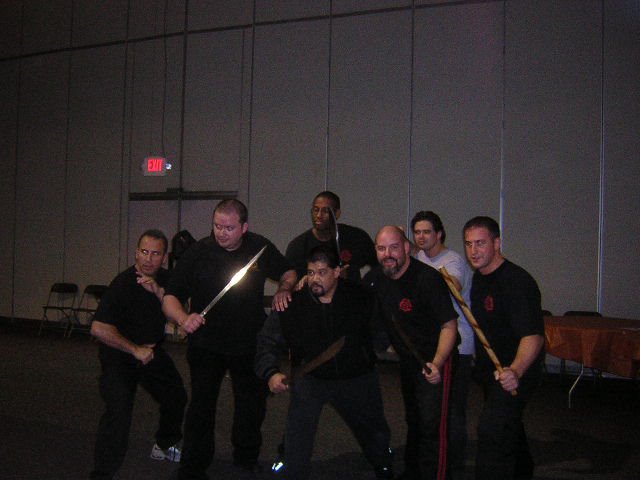
God Bless You All!

JD

Tuesday, December 06, 2005

The Rolling Tiger of Banten


Mas Gorka in Banten, West Java

The bonds between Michigan and Biarritz are strong. In the near future, I will be working more closely with the noble Basque warrior Gorka Echarri. I asked him to post a little about his practice on my blog, and it is with pleasure that I reproduce his article here. - JD

My dear brother Jeff asked me to write an article about Cimande...
This really nice offer put me in an odd situation because I've seen in the past that this word "cimande" is the subject of so many wars between schools in the "western part of the world". Anyway, I'll try to share my little knowledge and my personal experience, hoping that it will be able to clear the path of some true seekers.

To start I've to be really clear about the word Cimande. There is a saying in the pencak silat comunity that says that Cimande is like a broken glass. When you drop a glass on the floor there are a hundred pieces of glass on your floor but none of these pieces can say "hey ! I'm THE REAL glass" in truth all of them are the glass. In the same way, Cimande is like the broken glass and each school of Cimande is part of the same art, and none of them can say "hey ! I'm THE Cimande".

So what I would like to share is just a part of Cimande. This part of Cimande is the one I've looked for in the villages of West Java, in the Banten region, in the village of Serang. There, in this village, people are playing Pencak Silat like in France we are playing soccer, I would say that 70 to 80% of the people I've met are playing Pencak Silat.

The Cimande style that I've been taught is called Cimande Macan Guling. Cimande is the name of the style and Macan Guling (Rolling Tiger) is the name of the school. This school is very famous and very well known in Serang. They're under the authority of the PPPSBBI (Persatuan Pendekar Persilatan Seni Budaya Banten Indonesia) a very famous regional organisation. PPPSBBI has got 500 000 Silat players in West Java with 90 different styles. This organisation has been created in 1971 by Pendekar H. Tubagus Chasan Sochid a very famous man with a big charisma and a great influence on Banten region. PPPSBBI has been created to protect and develop all the traditional Pencak Silat styles from Banten (what they are doing is great...). In Cimande Macan Guling we've got jurus (codified movements), Langkahs (codified steps), Kelidans (arms game to develop reflex, hardeing the arms...), Golok (machete) jurus, pisau (knife) jurus, toya (staff) jurus, sarong jurus... Its a very wide style with a lot of material to learn.

Beside this technics knowledge there is 2 rituals very important that are done to accept a new student within the Cimande Macan Guling family. The first one is called Pangurutan or Urut. It's a ritual during the one your arms are beaten hardly by a top teacher (guru dewan) with a ritual oil, a flower bath and prays. This rituals has to be done 7 times. The second ritual is called Keceran it's a ritual that is done once a year during which you receive drops of a sacred water in
your eyes. In Cimande Macan Guling, there are a lot of "great teachers" (guru dewan) and each of them has a speciality (the pangurutan, the kelidans, the jurus...) so when I go there I often train with several teachers and it can give me a large view on this great style. I hope that this short text can help the true seeker to see clearer in the wide world of Cimande

Gorka Echarri - Biarritz - France

Monday, December 05, 2005

Silat Melayu Issue #4 (and Counting!)

I have just received the fourth outstanding issue of the ezine Silat Melayu. I told you guys this was great stuff. To give somewhat of a "peek" into the nature of a few of the topics covered in Silat Melayu, I would like to reproduce here an on-line discussion between Saiful Azraq and myself which took place several months ago (yes Saiful, I have saved every one of them.)

My initial question to him was: "Why is there such a reluctance on the part of Malaysian Silat teachers to show the 'real thing' during demos" Saiful's observation is below in italics:

In the 1940s-1960s, Malaysia was overrun by Judo, Karate and Taekwondo resulting in many Malays looking down upon the low-key, humble Silat. It wasn't until four masters, all brash in their own right and ahead of their time decided to play the karate game and created fancy demonstrations of power and coordination

Cekak did away with the flowery movements and went straight to fast-paced rock em sock em demos and trained just as hard and fast. Gayong incorporated karate-like reverse punching and blocking to standardise the demo movements and so did Lincah

Gayung Fatani although still flowery, sped the movements up and put a guy in front to replace the 'shadow' that was there once and \get beaten. I've seen Gayong demos and they look nothing like what they train in.

Just like Cekak. There are three kinds of Cekak. One for demos (which is flashy and hard), one for training, (which is boring and repetitive) and one for combat, (which is very, very deadly an requires minimal locking)

You have to understand, real silat is nothing to look at. They had to diversify to make it more interesting for youth to identify with. It's nothing to see with a guy standing one second and lying down the next.

My next question was "Why were the Malaysian Silat teachers that Donn Draeger mentioned in his book so secretive?"

Remember this, Malays became a colonised race in 1511 and gained independence in 1957
Many promises were made by the Portuguese, Dutch and English and many more were broken. Trust did not come easily to the Malays when a white man they associated with colonisation was asking them about the one remaining thing they could keep a secret. Nowadays, with a strong background in law and knowing their rights, more silat are willing to open their doors, but learning from the mistakes of the Indonesians.

Anyway, Silat Melayu is probably the best resource out there for the non-Malay Silat enthusiast. Cikgu Nadzrin and his worthy colleagues have answers that we don't even have the questions for...yet. My order stands: Check it out!

Wednesday, November 23, 2005

Be Advised!


Dearborn, Michigan 04/2004

That man with the training knife facing Tuhon Gaje is a certified Bad Ass!

HUUUUUAAAAAH!

Monday, November 21, 2005

Got Keris?


Martin with Empu Jeno


Mas Martin Notohardjo is the President/Curator of Pojok Keris Singobarong (Singobarong Keris Corner) in Central Java. It was by Mas Martin’s kind invitation that I was able to learn about the keris and other Indonesian Pusaka in Central Java in September, 2000.

Martin has an extensive network of contacts all over Indonesia. He can locate and acquire virtually any Indonesian weapon (or variations thereof) in any condition, of any era you can think of - with 100% authentication. In some cases, he can even do keris appraisals via digital photograph. If there is anything at all you need to know about the keris, then this is your man.

If you would like information on purchasing keris, keris appraisal, or even locating reputable Silat teachers in Indonesia, email me and I will be happy to forward your request to Mas Martin.

Just to clear up some mis-understanding that I have seen in print, Pojok Keris Singobarong does NOT sell or give keris/pusaka from any Kraton in Java. I say this because some clown has been known to foist faux Kraton items to other clowns, sourcing it back to PKS. Well, it’s not so.

There’s no Easter Bunny either.

Akiyesi!

Several interested folks have asked me for more information on Ode Remo (see a few postings back) Well, there is a new book called: Orisa - Yoruba Gods and Spiritual Identity in Africa and the Diaspora (isbn 1-59221-374-x) which contains a paper by Kevin Noel Amherd entitled Ifa Texts: Diversity and Discourse - this is positively the best exposition on the history of Ode Remo that I have seen anywhere in print. One of Kevin's informants is John Abiodun Ogunleye, the martial artist I had the friendly match with as detailed in my "Challenge in West Africa" post.

I met Kevin a few years back in Oakland, Ca. While we may have had slightly differing opinions on martial arts, I applaud him for undertaking such a serious, scholarly examination of Ode Remo from a unique perspective.

Ore're!

Sunday, November 20, 2005

NEW SILAT MELAYU E-ZINE!

Hey Everyone!

The emminent Silat scholar/resercher/practitioner Mohd Nadzrin Wahab has published two issues of a brand new Silat e-zine appropriately called SILAT MELAYU. I cannot recommend this work highly enough. It just so happens that the second issue features an outstanding article about a certian Silat Kuntau Tekpi group in the Midwestern United States.

Subscriptions may be ordered by emailing:

silatmelayu@gmail.com

I command you all to subscribe (its free)

Wednesday, November 16, 2005

Senaman Tua

In response to numerous requests from my students for more information on Senaman Tua, I offer the following brief explanation from our friend Saiful Azraq. As anyone who has been put into at least one full-body lock from Cekak or Silat Kuntau Tekpi can attest, it is murder on the joints. I liken Senaman Tua to 'yoga' for the joints. We have been doing it for 7 months, and I have seen remarkable results in my students strength and flexibility.

By way of a personal testimony, in the summer of 2004 I tore the ACL in my right knee during a dumog match. After 3 months of physical therapy I decided not to have surgery, but the knee was obviously not fully functional. I learned Senaman Tua from Omar Hakim in April of 2005, and after a rigorous program of x2 per week for an hour my knee was stronger than it was before the tear - by July!

I recommend either 15 minutes a day, or 1 hour twice per week. Maintain each exercise from 1 to 99 seconds, and remember Nafas Melayu...

Now from Brother Saiful:

SENAMAN TUA literally means Old Exercise but to do it justice, I
prefer to translate it as Sagely Exercise. The word TUA in Malay
commonly means old in English. However, the difference between our
cultures makes miscommunicates the term. TUA comes from the Archaic
Malay/ Sanskrit word TUHA which means Prime. From this word comes
TUHAN (God), TUA (Old), colours like BIRU TUA (Dark Blue), KETUA
(Leader), PENGETUA (Principal) and many others. In the Malay culture,
the old are revered for their wisdom and surpassive knowledge.
Therefore, SENAMAN TUA means the knowledge of human exercises that
have arisen out of hundreds of years of research and development,
experimentation and testing. Each of them bear a deep amount of wisdom
within them.

However, another interpretation of SENAMAN TUA as explained by its
founder guru Azlan Ghanie is that it is a shortening of PETUA which
comes from the Arabic word Fatwa. A fatwa is a conclusive decision or
result of detailed research and development by a master in a
particular field. For example, e=mc2 is a fatwa of Einstein who
reduced the relationship of energy and matter into five symbols.
Therefore, the SENAMAN TUA is bound by a minimum of four PETUA, Nafas
Melayu, Lam Alif, Mata Angin and Jantan Betina. There are more but are
merely extrapolations of the four.

Tuesday, November 15, 2005

NY Seminar


"It's All Fun Until Someone Loses An Eye!"
(Jeff & Doug doing some "Knife-Clowning")

Hosting a public seminar is never an easy task. Co-ordinating 3 seminars in two countries on the same weekend is a feat that most sensible people would not even want to attempt. I am proud to say that my friend, teacher, and mentor Guro Doug Marcaida of Rochester, New York did just that - and flawlessly - this past weekend.

The event began on Thursday afternoon with Guro Doug and Tuhon Gaje presenting a Pekiti Tirsia knife and gun seminar to SWAT groups from all over New York, including Homeland Security. Friday evening featured another well-attended civilian seminar in Rochester by Tuhon Gaje covering double knife and dumog.

On Saturday we were able to spend some quality time training with Guro Doug, literally picking up where we left off almost a year ago since our last Detroit/Rochester group training. Later in the day, it was off to Toronto where we were joined by the incomparable Guro Jun DeLeon in preparation for the final day of instruction on Sunday.

Pekiti Tirsia is experiencing a rebirth of sorts in the United States. Guro Doug is at the forefront of this movement, as it were. He has studied with the greatest of Tuhon's 1st generation students, and his high level of understanding and refinement allows him to distill the very finest wine from the grapes of Tuhon's extensive knowledge.

It was an honor and a privilege for my students and I to share some Silat Kuntau Tekpi with Guro Doug, as well as just to be a part of this outstanding event.

Maraming Salamat
Doug.

Saturday, November 05, 2005

The Players


Maphilindo Demo Squad 11/04/2005

From left: Bassam Hammoud, Dean Hadin, Jamal Hakim Abdullah, Guro Davidson, Jeff Danuloff
Back: Damon Mitchell Darryl Mundrick

GREAT JOB GUYS!

Another Great Demo


Guro Davidson with Hamisi and the Rah African Drumming Ensemble

Our most recent demo took place at the Southfield Civic Center pavillion, and was sponsored by Aloha Tropics. This festival featured a multi-cultural lineup of Indian, Hawaiian , Filipino, and Spanish folkdancing, as well as African Drumming and Filipino martial arts.

The Detroit Maphilindos are grateful to our new friends, The Rah African Drumming Ensemble from Mt. Clemens for providing outstanding live percussion during our set. Now, most drummers in Detroit are so heavily influenced by Cuban modes that even when they try to play traditional African rythmns, it still sound like Salsa. This group was different, however. Their playing was so inspirational and "in the pocket" I literally could not stop moving! Even after our part of the demo had concluded, Hamisi and his group played on, so that I had no choice but to take up a sword and dagger and go where the Spirit led me.

Hamisi is a practitioner of Filipino martial arts himself, and we discovered that we have several friends in common in both the martial arts and percussion scene in Detroit. Small world...eh?

Gentlemen, I say to you "A dupe pupo!" I hope we have the pleasure of performing together again soon.

Ashe!

Wednesday, November 02, 2005

French Cimande Par Excellence


Guru Gorka Echarri with Cimande Masters

My good friend of many years Guru Gorka Echarri of Biarretz, France is the French Director of the Cimande system of Pencak Silat under the auspices of Persatuan Pendekar Persilatan Seni Budaya Banten in West Java.

The Cimande system is one of most prolific, yet misunderstood systems of Pencak Silat from Java. Wild misconceptions about this art abound, especially in the United States. I admire Guru Echarri for taking the initiative to go directly to the source in Indonesia for the Truth. I invite all French speakers to visit his impressive website at

http://www.cimandefrance.com

Gorka is very fluent in English, and I'm sure he would be happy to answer any questions from those seeking knowledge of authentic Cimande and Terumbu as practiced in Indonesia. For the record, let me just say that there is NO "Leader" or "Guru Besar" of all Cimande styles - especially not in the United States. There are various lineages of Cimande from the late Pak Herman Suwanda and others. There is also no single "Superior" or "Legitimate" Cimande style even in Indonesia. Just like any other martial art, there are different interpretations, each with its own merit.

As they say in France, "Vive la diference!"

Monday, October 17, 2005

Filipino/Chinese/American Military History

The resident 'Pandai' (Bladesmith) of the Detroit Maphilindos - Ungyo - who has a mind for history as sharp as one of the blades he forges -was kind enough to send me the following tidbit of Military history... JD


Some background on Ward, taken from The Devil Soldier: The Story of Frederick Townsend Ward, The Most Honored and Controversial American in Chinese History , by Caleb Carr:

A soldier of fortune who became a military genius of astounding virtuosity, American adventurer Frederick Townsend Ward fought with William Walker in Mexico and in the French Army in the Crimean War. But it was in China- a country that always exercised a powerful hold over him- that Ward would conduct one of the most extraordinary military campaigns in history.

In 1859, the local Chinese authorities of Shanghai were faced with the approaching rebel army of the Taipings; cornered, they looked to the local western population for help in defending the city. At this crucial stage of the Taiping rebellion- the most bloody and destructive civil war the world has ever suffered- Frederick Townsend Ward emerged as the man able and willing to take history into his own hands.

Ward built the Ever Victorious Army- otherwise known as The Devil Soldiers - in response to the mounting rebel threat/. While leading this highly successful force of Western trained Chinese soldiers, Ward was wounded many times, imprisoned by the British on a warship (from which he made a dramatic escape) and naturalized as a Chinese citizen. He eventually married the daughter of a Chinese mandarin, won a string of critical victories against the Taipings, and was awarded a generalship and a mandarinate of his own.

By June of 1860, Ward had a polyglot force of 100 Westerners, trained in the best small arms (including Colt revolvers) and rifles available for purchase in Shanghai. Protesting that his forces were not fully trained, Ward was forced by his Shanghai backers to take his men into action alongside Imperial forces probing Taiping advances, retaking two captured towns. They were then forced by circumstances (and the urging of their Shanghai backers) to assault the Taiping occupied and fortified city of Sung-Chiang, without artillery a near impossible task. The attack failed, sending the thoroughly defeated force back to Shanghai.

The Foreign Arms Corps had no siege equipment, a deficiency Ward hoped to overcome by attacking at night and, with luck, achieving surprise. But the men of the corps- perhaps overly impressed by the part they had played in he two earlier victories- brought large amounts of alcohol with them on the Sung-Chiang raid. By the time they were making their way across the flat, grassy terrain outside the city, they were making so much noise that the Taiping sentries were alerted to their approach. The corps suffered heavy casualties and was thrown into flight. ̃The miserable survivors, Dr. Macgowan wrote, "returned as stragglers to Shanghai, utterly disgusted. They were paid off and disbanded." (Carr, p.90)

Now get this...


In the face of this disheartening spectacle, Ward dismissed almost all the men, retaining only those who had demonstrated bravery and ability and whose arrogance might be transformed, with time, into something like authority. These few would become officers. But they would need men to command, and it was now necessary to rethink old notions about who in Shanghai would make the best soldiers of fortune. Ward took to the waterfront once again to grapple with this riddle and soon made an acquaintance who facilitated a solution.

Vincente Macanaya was twenty-three in 1860 and one of Shanghais large population of Manilamen - Filipinos who were handy on board ships and more than a little troublesome on land. Renowned as ferocious fighters, especially at close quarters, the Manilamen were in a class with the famous Lascars of Malaysia and the pirates of the Bay of Bengal, groups that were also known to frequent the foreign settlements in Shanghai.

Macanaya himself- who would, after his initial acquaintance with Ward, be known throughout Shanghai simply as Vincente- had been born in Manila and was a seasoned young man of singular courage. As Charles Schmidt, who swerved with and knew him well, wrote while Vincente was still alive:

"If real bravery consists in an undauntedness of spirit, a cool presence of mind, and active physical exertion, then all these qualities are combined in Vincente to a degree that leaves no doubt on the minds of the many friends who know him, and have seen him so fearless in the midst of danger. He has all the appearance of a soldier. There is nothing rough about that appearance. [He is] gentlemanly in his ways to all, kind hearted to his friends, sober in his habits, quick in perception, frank, liberal to a fault, and with an eye always to duty, serving faithfully where he serves, beloved and respected by his comrades in arms."

Friday, October 14, 2005

Some Malaysian Silat Info

The following information stems from a correspondence between a student of mine and a highly knowledgeable and well-spoken Silat teacher in Malaysia known as Saiful Azraq. - JD

Silat Cekak Hanafi & Silat Kuntau Tekpi
Based on my encounter and studies, all of the arts have the potential
to be a softer, more circular art depending on who teachers it. For
example, I studied Silat Cekak Hanafi when I was 18 from instructors.
The way the syllabus is performed by the instructors is undoubtedly
hard, fast and brutal. However, watching my Principal, Tuan Guru Md.
Radzi Haji Hanafi execute the very same moves, is like watching a more
streamlined version of the buah. Physically the look is the same, but
has less of an edge to it.

Conversely, I studied Silat Kuntau Tekpi from cikgu Norazlan Wahid,
incidentally also cikgu Omar's immediate teacher. Cikgu Norazlan
already has a softer edge to him and those who study under him tend to
flow easier through the buah. An example, when I visited cikgu
Amirul's gelanggang in AU3 Kuala Lumpur, he was still in yellow belt
and training under cikgu Azhar. When we performed the same buah on our
partners, I completed mine before he managed to. Both of us were
surprised and cikgu Norazlan confirmed this difference due to cikgu
Amirul studying the syllabus 'by the book' while I studied it in terms
of flow. This is not a difference in quality, simply method.

Silat Kalimah, on other hand as taught by guru Eusoff Ali (aka Pak
Jauhari), as a 63 year old man is far softer and economical than Silat
Kalimah as taught by anyone else. Previously, SK was as brutal if not
more than SCH and had a harder edge. Twenty years of thought and
development (and 3 months of discussion with cikgu Omar and us) and
Pak Jo has redeveloped the Kalimah syllabus into a more economical
version, correcting and compensating for problems inherent in the
present SCH syllabus. You won't find this development in other Kalimah
syllabi.

Just so you don't get confused. Silat Kalimah in Malaysia is in a
fractured state. After guru Yahya Said taught Allahyarham Ustaz Hanafi
in 1965, he established Silat Kalimah sometime in the early 70s with
the assistance of cikgu Azmi Long and cikgu Radzuan Long. Due to
administration differences, guru Yahya set up Gabungan Kalimah, cikgu
Azmi Persatuan Kalimah and cikgu Radzuan Persatuan Seni Silat Kalimah
Malaysia. After guru Yahya passed away followed by cikgu Radzuan,
there was a drive to combine all current Kalimah students into cikgu
Azmi's organization but nobody could agree on it. This resulted in a
fracture that saw eminent students of guru Yahya setting up their own
organizations. Guru Zohdi Mat Yusof helmed Persatuan Seni Silat
Kalimah Yahya Said (comprising cikgu Radzuan's former Kuala Lumpur
students), Pak Muslim reregistered his state chapter of cikgu
Radzuan's organization as Persatuan Seni Silat Kalimah Amin and cikgu
Mazlan Man founded Persatuan Seni Silat Kalam Utama Malaysia (PIKUM).
There is no enmity between the organizations, but slight differences
in approach, and syllabi.

Within the Persatuan Seni Silat Kalimah Yahya Said organization (which
is not national, currently only comprises three states), there was an
initiative to create a federation between them and Silat Kalimah Amin.
Pak Guru Zohdi was appointed Guru Tinggi (I think this is the term
they used. Have to check. Sorry) while two other eminent masters, Pak
Muslim and Pak Jo were appointed Guru Utama under him.

When cikgu Omar expressed his interest to study Silat Kalimah, Pak
Zohdi recommended that Pak Jo teach him as Pak Jo had a better command
of English than he and the rest as you said, is history. Therefore,
the current syllabus being taught in the United States is Pak Jo's
version.

In comparison Silat Cekak Hanafi has 21 buah split into two levels of
advancement, Asas (Basic) and Jatuh (Takedowns) while Silat Kuntau
Tekpi has 42 buah and Silat Kalimah, 27 buah taught in the original
format of straight to takedown forms.

Silat Cekak Hanafi under Ustaz Hanafi espouses a very practical
spirituality, preferring to inculcate their students with simpler
methods of recognizing Tauhid. They are taught to never disobey their
mother, father and teacher, never to lie and always keep promises.
They place performance, hard work and diligence first. There is only
one common du'a practiced by all SCH pesilat and is provided at the
end of the syllabus.

For Silat Kuntau Tekpi, you will have to ask cikgu Amirul. He has
better resources than me on this. Seriously.

Silat Kalimah as I understand it is not any more spiritual than SCH
but the impression is there because of cikgu Omar's studying from Pak
Jo. There is a difference between studying from a master and an
instructor. Students also receive a similar du'a at the end of the
syllabus. I have not gone far enough within Silat Kalimah to elaborate
further.

Thursday, October 13, 2005

A Yoruba Poem


Jeff with Olori Egbe Obatala

Osa-Alawore (trad. Translated from Yoruba by Jeff Davidson)

Alapankoko!
One Sage is more powerful than another
One Sage can swallow another completely
The parrot flies to the top of the Iroko tree
and its voice is like an iron gong
All of them spoke for "The-Spirit-of-Destiny-Brought-Good-Things"
The first son of the Chief, who protects himself with his great Mind
He said: "Please inform Alara that I have met with good fortune"
He said: "Please inform Ajero that I have met with good fortune"
He said: "Please inform Owurangun, the owner of the Royal Chair that I have met with good forutne"
The lost good fortune has returned!
If good fortune enters the house, let us be calm in handling it
If we are quick-tempered or impatient, good fortune will retreat to the jungle
The Joyful! The Multitudes! I shall die in the midst of a crowd of children
I heard the dropping of star apples...children, please come 'round and gather apples for me
The Sneaking Cat Society...The Society of the Powerful
The Owner of Igodo Spring water, that people wake up early to fetch

It is the Sages who render the cobra powerless; It is the Sages who render the boa powerless
It is the Sages who render the leopard powerless in the dead of night
It is the Sages, the Dangerous Ones.

Thursday, October 06, 2005

"The Pioneers"


Due to the overwhelming interest in this Malaysian system, we have already formed a separate "Beginning" and "Advanced" class for Silat Kuntau Tekpi. Pictured above is the Advanced class of 2005.

Sunday, September 25, 2005

Another Great Silat Kuntau Tekpi Seminar


Sammy Performs Buah #8 on Eric

I'm pleased to report another outstanding Silat Kuntau Tekpi seminar! After a grueling hour of Senamentua, we covered the following buah:

- Kembang Layar
- Jerai Menumpang
- Lipat Sotong
- Patah Kemudi

Yet again, numerous applications from Pekiti were given for each technique. Its great that we have people of so many different body types to practice (or should I say "experiment") on. When we are locking and twisting our training partner, our main concern is for his safety. You can very well imagine the damage that could be done when the locking buahs are applied in real-time without regard for the opponent.

I encourage all of you to acquire a set of practice tekpi (also known as "sais") as I will be starting to teach some basic drills with single and double weapons in the weeks to come.

Tuesday, September 20, 2005

Honor of Honors - Batangas in Michigan


Ka Jay Saludo, Manong Leon Saludo, Jeff Davidson, Ka Eddie Panamaroff

I am still working on the photostory from our most recent seminar with Supreme Grand Tuhon Gaje. God Willing, this will be posted on the Maphilindo website within the next week or so. But I would like to share one part of that amazing week here on this humble blog right now.

In my years in the martial arts, I have been blessed to cross paths with some truly great teachers and practitioners. In the Silat world, Guru Hassan Ali (Brandt Smith) of KSMA; Pendekar Agus Hiriyadi of Setia Hati Terate; Pendekar Gus Fud of Perguruan Macan Putih; Guru Gorka Echarri of Cimande; Saiful Azraq of Silat Cekak Hanafi; and Ustaz Hussein Udom of Silat Mubai have each gifted me in their own way and I am honored to count them as Brothers.

In the Pekiti Tirsia world, Guro Omar Hakim; Kuya Doug Marcaida; Ricky Rillera; Robert and Steve Slomkowski - all of whom I have had the honor of training with and Guro Jun DeLeon of Kali DeLeon for even the precious little he has shared with me over the years when we have been together at seminars.

And of course our leader, Supreme Grand Tuhon Leo T. Gaje Jr. whose mantle of Pekiti Tirsia we carry with pride and honor - is the one responsible for putting my feet firmly on the Path!

Perhaps our closest friends in the martial arts community - and life - are the Pekiti Tirsia clan from Saskatchewan, Canada headed by the furiously talented Ka Jay Saludo. Ka Jay and his students are our Blood Brothers in Pekiti, and together with Kuya Doug Marcaida make up the "Tri-V of Power" (Detroit, Rochester, NY & Saskatchewan) dedicated to the refinement and progression of Pekiti Tirsia and Filipino Culture.

The quiet patriarch of the Sask' Pitbulls is Manong Leon Saludo, of Lipa City, Batangas. In October of 2003, in Rochester, New York Manong Leon gave me a brief and utterly terrifyng demonstration of the knife-fighting style developed in his province of Batangas. This system has been born, bred, and honed through countless knife fighting encounters in the home town of the infamous Balisong. I will not divulge the "proper name" of this style right now for my own reasons, but it is sometimes known colloquially as VIENTENUEVE. After this personal demonstration in New York, my main priority with regards to this system was to learn how to not get killed by it. As I have said in previous posts, it is probably the most dangerous knife system I have seen. I don't care who you are and what your training may be...unless you are Tuhon Gaje...if you are ever misfortunate enough to face a knife-wielding Batangueno, you are going to be rendered a horrible bloody mess in a very short period of time, and you are going to the Other World in shreds. Trust me.

There are less than a handful of Masters of this style alive currently - Manong Leon is one of them. It is very rarely taught today in Batangas, and it has NEVER been taught in the United States...

Until now.

On Thursday, August 26th, 2005 I had the honor of being formally accepted into the venerable lineage of the Vientenueve Style by Manong Leon himself at our training hall here in Detroit. I was awarded the title of "Dalubhasa" and am the third person outside of Batangas to have been taught by Manong Leon. The other two capable practitioners, much senior to myself, are Jay Slaudo, and Eddie Panamaroff. They along with Master Leon Saludo taught a select group of my students prior to Tuhon's seminar here last month. Although our instruction actually began in April of this year, it was during this most recent training experience that the true foundation of the Vientenueve style was passed to us.

I consider this one of the highest Honors I have ever received in over 20 years of martial arts.

Just as the Batangueno fighter carries two knives, so it is with us. We carry the Knife of Pekiti Tirsia firmly in one hand; and now hold the Knife of Batangas in the other hand. Although these two systems are different in theory and application, the common bond between them is our Love and Respect for the people and for the culture that brought them both into being - in the magnificent Land of the Philippines.

Wednesday, August 31, 2005

Next Silat Kuntau Tekpi Class

The second Silat Kuntau Tekpi class is tentatively scheduled for September 11th, 2005. We have many new members since the last class in July, and there were several people who were not able to attend that first session. Don't worry. You are welcome to join us in September, and will have the opportunity to make up the material you missed at a later date.

God Willing, I would like to finish up to the tenth buah next month. Also, I will be conducting a Silat Kuntau Tekpi seminar in Canada in October, covering Senamentua and the first 6 buah. All of my students who have membership in the Tekpi Organization are welcome to attend free of charge. See me in class for details.

Tuesday, August 30, 2005

What a Weekend!


I speak for all of us when I say that the past 5 days was the most intense training we have experienced to date in Pekiti Tirsia. Once again , the upper level of Gold's Gym was filled to capacity as Grand Tuhon Gaje delivered a furious, exhausting, and absolutely exhilarating public seminar that tested the mettle of all present. The torturous physical conditioning coupled with the down-and-dirty combative tactics made a few of us feel like we were back in the Philippines.

Then, after the public seminar, it was off to the Law Enforcement seminar hosted by the City of Dearborn. Patrol officers, SWAT officers, Tactical Paramedics, and Police Defensive Tactics instructors from across Southeast Lower Michigan turned out in force (excuse the pun) to meet and train with the incomparable star of Surviving Edged Weapons. Also in attendence were members of the Royal Canadian Mounted Police.

Among all of the remarkable things I could (and will shortly) say about this event, one great surprise was that we had almost as many attendees from out of the country as we had from our local club.

I promise that as soon as I have all of the pictures (there were several officers in attendance who work undercover, and we need to make sure that they don't show up in the photos) I will put a full report on the www.maphilindo.com website.


Saturday, August 06, 2005

Mailbag Pt. 2


Tuhon Gaje Torturing Me With Dumog (Indiana, 2003)

Here is the next batch of questions I keep getting via email:

What if any Pekiti Tirsia Organization(s) do you belong to?

I know there’s a few - and a few variations on curriculum. I’ll answer by saying that my students and I train directly with Grand Tuhon Gaje. We practice what he has taught us, the way he has taught us. We continue to refine our skills with other seniors in the Art from various parts of the United States who also are directly connected to Tuhon.

Can you explain more about the Batangas style of knife fighting? How does it compare to Pekiti knife fighting?

I do not have permission to say anything more than I already have regarding the Bantangas style. As for comparisons, how does a hand-forged ginunting compare to a sharpened kamagong stick? Both are weapons; both are extremely dangerous; however each is created in a different way. More concretely, Batangas is a “style” while Pekiti is a “system.” A Batangueno who has grown up in the culture learns knife fighting by living and applying it. Pekiti is a methodology by which someone who did not grow up with it can be made into a competent blade fighter.

What blade styles do you prefer in your art(s)?

For Pekiti, the ginunting is king. As far as a back-up knife, or daga, we use a custom made scaled down version of the ginunting. For Silat Kuntau Tekpi, we of course use the tekpi (aka cabang; trisula) and my personal favorite is the badik. The badik is a rather wicked knife...

Is there any grappling in your curriculum?

We have two grappling Arts: Dumog and Cambod. Dumog is an indigenous Filipino wrestling style popular in the mountainous region of Panay. People always ask two questions about dumog:

1) Is it practical against larger opponents?

Well, the farmers in Panay wrestle Carabao. Chances are you won’t face an opponent bigger than that...

2) Is it practical against multiple opponents?

I made the mistake of allowing one of my senior instructors, Sam Hammoud, to coax me into asking that question during one of Tuhon’s seminars last year. Tuhon had one of the students in a typical dumog control - meaning he had both of the guy’s legs painfully locked and was simultaneously applying a choke - when I raised the issue of multiple attackers. Tuhon invited me to attack, and very nearly broke my right leg in two - but for his excellent control. If he had followed through on that kick, I would have sustained a broken leg for sure, and probably a broken neck from the whiplash. In the video, I am knocked clear out of camera range. And he never released the first student from the choke or leg locks in the process.
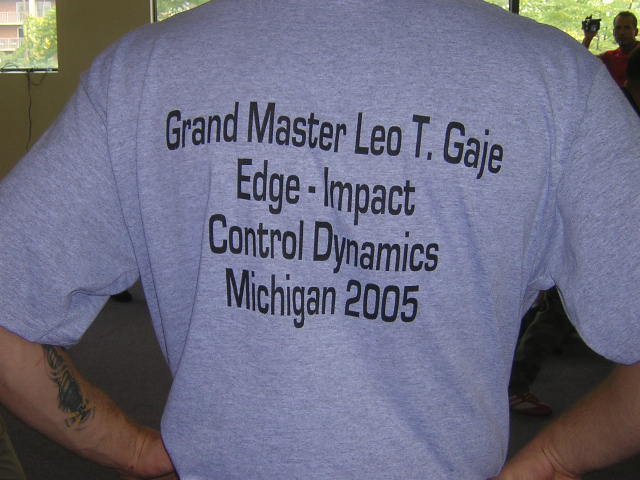
Cambod is slightly different than dumog, although the result ( ie. a crippled opponent) is essentially the same. If you look at a standard dumog combination from entry-to-lock-to-takedown-to-control, and then repeat the sequence moving in almost exactly the opposite direction on the opponents limbs, that’s Cambod. To my knowledge we are the only group in the United States that has learned Cambod from Tuhon Gaje.