Tuesday, January 25, 2011

Another Great One Has Departed


Wow. 2011 has barely begun and another of our beloved Elders has gone to his Great Reward. The legendary Afro-Cuban percussionist Eugenio Arango (better known as Totico) has passed away in New York. He was the teacher of one of my own conga teachers, and we were actually distant cousins - long story for another time.

In his honor, we will feature his music this week during classes. VIVA TOTICO!

Thursday, January 20, 2011

New Logo is Here!

Brotherhood of the Blade Logo 2011

It’s not only the www.maphilindo.com website that has a new look for 2011. Our own Kuya Doug Marcaida , after months of painstaking work has finally put the finishing touches on the official new logo of The Brotherhood of the Blade. So far the new design has met with rave reviews from students and supporters alike. Word has it that this very image has already been uploaded onto cell phones, screensavers, and profile pics across the cyber-sphere.

It is possible that those unfamiliar with the Brotherhood of the Blade may get the wrong impression or otherwise misinterpret the logo, so we thought some clarification may be in order.

The Brotherhood of the Blade is all about martial arts, but it is not about fighting. Obviously, martial artists love to fight; a big part of the problem is they don’t know when to stop. You see, fighting is no challenge. The REAL challenge is getting along with other people in a noble way…in a way that fosters Respect and Loyalty, instead of back-biting and contention.

Kuya Doug, Ka Jay, and I all know what an absolutely miserable experience it is to part of a dysfunctional Martial Arts organization. We created the Brotherhood of the Blade to be all the positive things we wanted for ourselves and our students. The only ranks and titles belong to our Teachers – Ama Guro Jun De Leon, Tuhon Leo T Gaje Jr., and Manong Leon Saludo. Respect is for everyone.

We have never been in competition with any other “branch” of any System. We respect everyone. Those who support our efforts, we support in return. Thos who don’t – we simply choose to ignore with no hard feelings (I promise!) Anyone who displays honor, respect, a passion for learning Kali, and is willing to be supportive of the group is able to join us. Just remember, you have to prove it first.

Our only agenda is to refine and grow. And most important of all – we have a lot of fun doing it!

And now the explanation of the logo from someone who really understands our purpose:

The logo design of expression, there are several meanings to it.

The three hands are of the three main Elders of The Brotherhood whom we never forget. Also the Three original founding members who started it - but mostly it shows the hands supporting each other...that support is what Brotherhood is about.

It forms a triangle, the geometric pattern found in FMA, the most solid shape, the most solid foundation. In numbers there is strength and in a pattern where they can lean on each other for support. The hands extend to hold the weapons, which are the basis of our Passion. We are a Blade-based art.

The background is taken from the Philippine flag. The Sun’s rays of illumination of something that is positive and good. It shines upon a brotherhood to show a glow of good things - a fellowship like this is about shining because of the good it does.

We do not compete with against each other; we help and support each other. The points of the rays explode outward. The patterns of movement are infinite…

Sunday, January 16, 2011

New Look for '11

No, hell hasn't frozen over. Its just that finding a reliable web guy is like finding a good Kali instructor. Luckily, I managed to get one - from India, of all places. My good friend and Gurubhai Abhi gave the old www.maphilindo.com website an overhaul. Please have a look and feel free to give me your thoughts and suggestions either here in the comments section or via email.

MABUHAY!

ps. This guy does great work and he is very reasonable. I'll be happy to pass his info along to any that are interested.

Wednesday, January 12, 2011

...Gone to Soon

Ricky Rillera


Kuya Ricky Rillera was a Brother, dear Friend, and Elder to me. He was also one of the most wonderful human beings you could ever be blessed to know. This world is a poorer place for his leaving it – but it is also richer for the marks he made in the lives of all who knew him.

Brother Ricky, we remember you every single day. I am eternally grateful for everything you shared with my students and I – we are all better people for it. We humbly pray that God rests your Soul in Peace.

I also pray that I merit the opportunity to train with you again…some glorious day.

Al-Fatihah.

Sunday, January 02, 2011

2010 Continued: Silat Melayu


Some time in April of 2005 I was sitting over a late dinner with Cikgu Omar Hakim in Austin, Texas discussing various topics in Silat Melayu. We spoke about the similarities/differences in Silat practice in Indonesia and Malaysia, as well as the many fallacies and misconceptions surrounding the phenomena of Silat here in the West.

At one point, Omar was reminiscing about his experiences with different Masters in Malaysia, where he studied under some of the greatest. He spoke at length about Pak Jauhari, venerable Master of the venerable Silat Kalimah – which could be considered a “cousin-system” to the Art I practice – Silat Kuntau Tekpi. Omar related “Whenever I would attack Pak ‘Jo, as soon as he even put a finger on me, he had me totally locked to the point where I couldn’t even roll my eyes!”

For those of you that have the pleasure of knowing (or even having seen) Cikgu Omar, that’s a pretty impressive declaration for him to make about anybody, let alone a typically smaller-stature elder Malay. That vision stayed foremost in my mind throughout the following period of study and research amongst my own group here in Michigan.

We spent a good part of the next few years refining the physical aspects of practice, namely the 42 buah (strikeforms) which encompass pukulan (percussion), kuncian (locking), and buangan (throwing). This was not such a simple endeavor considering that Silat Kuntau Tekpi in theory and practice is very different from Kali in almost every respect.

This year in particular, with the gracious support of several Elders in Malaysia, who for the sake of humility have requested me not to ‘brag’ about them on this blog (except for Nadzrin!) we have achieved an understanding of – and the ability to teach - the intrinsic Petua (Principles of Movement) that put the true ‘soul’ into the techniques, and mean the difference between merely imitating a technique and actually producing the desired effect with a minimum of effort. A recent class gave me a nice bit of confirmation: during buah practice, I observed a beginning student (a veteran of exactly 2 prior Silat Melayu classes) completely immobilize a senior student approximately twice his size - within seconds of the attacking feed – using only the elbow of the attacker.

Also in 2010, we had the pleasure of introducing Silat Melayu to groups of experienced martial artists and laymen through various seminars in the U.S. and Canada.

We’re working on some very exciting projects with our friends in Malaysia for 2011. God Willing, it’s going to be a banner year!

Saturday, January 01, 2011

2010 Continued: Barako Batangueno


After a five year apprenticeship under the redoubtable Tito Jun Saludo, I was (unexpectedly) awarded full Instructor status in his personal style some months ago. Even with a high degree a familiarity with this method, I have to confess I am no less intimidated by it today than I was at my first taste five years ago. As one of my students puts it: “Pekiti bladework is scientific, disciplined, and efficient…Barako is just your worst nightmare with a knife.” I’ll second that.

Our training with the Saludos this year focused on some different aspects from times past. Ka Jay spent a great deal of time and effort in codifying the logical footwork pattern to flow with the “template” of 29 basic attacks. One comes to realize that the footwork and body positioning – as counter-intuitive as it is to typical FMA – does as much to hide/assist the delivery of the final lethal angle as the knife-hand itself. So we have been hard-wiring in the footwork.

Tito Jun himself gave us far more than expected during this year’s training. After a demonstrative review of our progress thus far, Tito subjected each student to a full out ‘pressure test’. If he had been using a live blade – or even anything with a sharp point – my whole cadre of senior students would either be dead or out of commission for a long, long time. Following this test came a comprehensive critique of each student’s performance, along with specific directives for improvement. We can’t wait to see what next year’s test will be.

Ever true to his word, Tito never wasted any precious time last year on “trivial” matters like empty-hand striking and grappling. As far as Barako is concerned, it has been –and continues to be – all about the blade!

Wednesday, December 29, 2010

Kali De Leon


Many people have asked me: “What is the most valuable thing you’ve taken from your study of Kali De Leon so far?”

That’s an easy answer. I can sum up the most valuable aspect of our involvement in KDL with three words: Ama Guro Jun. I simply cannot say enough about what a rare individual is Ama Guro Jun De Leon. For those who were moved by my previous post “The Heart of a Master” – it was inspired by him. He has a Heart as big as all outdoors, but by no means does he suffer fools. I’ve known him to reject more potential students than most instructors end up teaching. So if your ultimate goal is to study Kali De Leon, your first goal should be to become the kind of person that Ama Guro would accept as a student. People think we’re exclusive, but he’s in a class by himself there.

I can answer that question another way as well. Ama Guro Jun may get angry with me if he deems me to be incorrect, but here it goes. The most common appellative placed after Kali De Leon is not ‘Style’ or ‘System’ but Methodology. That’s very important. On the technical side, Ama Guro’s training methodology is by far one of the best I’ve experienced inside or outside of FMA. I’m convinced that whatever Art you practice, the KDL Methodology of training can make you better at it. Ama Guro’s mastery of range, power, body mechanics, and economy of motion is PhD level – as is his ability to see and develop your highest potential as a student. At our last meeting, he confided to us: “I’m so tough with you guys because I want you all to be the greatest generation of FMA practitioners.”

We were fortunate to have had several opportunities to train with Ama Guro Jun this year. I can see a huge positive difference in my own development, and my students have been transformed. I also had the distinct pleasure of introducing/teaching Silat Melayu at this years annual camp in Toronto.

Sunday, December 26, 2010

Pekiti-Tirsia with Mandala Rommel Tortal


A lot of people with a lot of different backgrounds came from a lot of different places to study Pekiti-Tirsia with us this year. It’s been a while since we’ve had this many beginners. It forced us to really nail down a standard curriculum based on what Grand Tuhon Gaje has shared with us since 1999. One of our main goals was to maintain the “unique-ness” of our own Pekiti-Tirsia training – based on the Tri-V and Contra-Tirsia methodologies with the baston and daga. As I’ve said before, some people expect something a little more ‘familiar’ when they come here for Pekiti-Tirsia. We follow the curriculum exactly as it was given to us – for us - by Tuhon, and I’m not one to second-guess him for our training.

In particular, we put a lot of emphasis on codifying and refining our practice of Dumog (grappling), and Pangamut (striking). I have always been in awe of Tuhon Gaje’s hand-to-hand combat. In my opinion, it stands right up there with – and surpasses – even the best of the Southeast Asian, East Asian, and Western “hand systems”. We have been joined this year by practitioners of such diverse arts as: Hsing-I and Tong Bei Kung-fu, Muay Chaiya, Pukulan Betawi, Silat Mustika Kwitang, and Greco-Roman wrestling. Some of these good people had a harsher introduction to our empty-hands than others, but the consensus is the same in the end: "F#$k! I didn't realize you guys could fight without knives!"

There is a misconception that Pekiti-Tirsia Kali is strictly a “weapons system”, and that one needs to supplement it with some other martial art to be ‘complete’. I’m here to tell you that’s not true at all. Dumog and Pangamut may not be the best choice to help you win an MMA contest, but it will give you the perfect, and necessary compliment to your weapons training – for COMBAT – not sports.

The highlight of this year for us in Pekiti-Tirsia was the opportunity to train with our old friend Mandala Rommel Tortal. In our informed opinion, Rommel has the most fluid (virtually seamless) integration of knife-stick-empty hands of anyone next to Tuhon Gaje. He is also a great and very energetic instructor. In our last training session, he indulged my urgent request to go deeper into Pekiti-Tirsia empty hands. It’s been a long time since someone has thrown me around like he did, but it was worth every bruise, strain, and contusion. My advice is to seek him out if you can. I promise he will remove any shadow of a doubt regarding the viability of Pekiti-Tirsia as an empty-hands system.

The good news is that we expect to be seeing a lot more of him right here in the United States. I encourage you all to come out and show your support. My students and I are ready and willing (just next time someone please remember to bring the ibuprofin).

Looking Back: Looking Ahead


Wow, what a year this has been. In all honesty it will damn hard to top this year, but we will try our best to do so in 2011. In the coming posts, I’ll try to summarize just a bit of what we’ve been up to lately.

Sunday, December 19, 2010

Guro's Public Service Announcement 2

Behold the terrible scourge that has swept the ranks of FMA practitioners everywhere:

The Balisong!

Up until the early 1980’s, this addictive pastime was all but unknown on our shores. Largely relegated to shadowy people practicing strange disciplines in near-secrecy. Suddenly, every ninja and bad guy in every cheap martial arts movie/tv show was wielding one. You couldn’t even open a martial arts magazine or equipment catalog without being bombarded by page after page of advertisements for the so-called “Butterfly Knife”, or “Ninja Knife”. Soon after, there were books, instructional videos, “collector’s editions” and the new, terrible fad was upon us like a storm.

HOW IT STARTS

It begins innocently enough. A student notices one of these implements of obsession placed quietly on a shelf or table in the training hall. Then, like a moth to the flame he’ll invariably say something to the effect of “You know, I’ve always wanted to learn how to use one of those!” and so it begins.

At first, they buy a cheap, crappy model at the local flea market. They bring it to their next lesson and the instructor (like a good dope pusher) will show some basic openings/catches. That’s usually enough to hook them. Next thing you know, they’re buy two and three at a time – in all price ranges. Then they’re accessorizing carrying cases. Then they’re asking for advice on “tightening the pivot pins” and throwing about terms such as “safety handle” and “Batangas Latch vs. Manila Latch”. Oh woe!

OTHER SYMPTOMS

You can always tell by the band-aids. The typical addict in the early stages will have at least a few freshly stained band-aids about the palms and fingers. I’ve also learned to check the feet or shoes. Puncture wounds on the lower extremities (from dropping the knife) are common indicators. Eventually, the Balisong addict will develop a nervous, instinctive reflexive reaction of pulling up the foot quickly while manipulating his knife. One hapless addict whom we’ll call “John B” actually placed his stocking’d foot directly underneath a falling balisong, rather than having to deal with his wife’s anger over all the new holes in their freshly sanded hardwood living room floor (I mentioned that it strains relationships).

I’ve seen the best of friends become bitter rivals within weeks as each tries to one-up the other with his balisong flashery. The spirit of sharing and cooperation is all but destroyed: “Hey show me how you did that opening you just did!” “No way. Figure it out yourself.”

Next come…the videos. You receive youtube links via email at odd hours of the night, when normal, healthy people are surfing for smut. Then they text the links to your personal phone in the middle of the day. Imagine my horror as a teacher when one of my students, completely new to the martial arts, suddenly began to post his own balisong videos– showing skill with openings, closings and catches THAT I NEVER EVEN TAUGHT HIM! (evidence of infidelity of a heinous sort).

It can bring out the dark side of even the most upstanding individual. Years ago, a certain student whom we will anonymously refer to “Panday X” innocently gifted me with an old Balisong that his father – a veteran Law Enforcement officer – had previously taken off the street in an act of selfless service to the community. In good faith this Panday X said “I don’t really know anything about this knife Guro, so you please have it.” Only a matter of days later, this same gentleman, after observing me manipulate the balisong uttered the following oath “Gee, now that I see what it can do, I’m sorry I gave it away!” (Hell no I didn’t give it back to him either!)

WHAT YOU CAN DO

As with all addictions, it’s best not to even start. Instead of Kali, try martial arts like Jiujitsu or Karate. After all, when have ever seen someone completely obsessed with a bo staff or nunchaku? Or even traditional Kung-fu. A Shaolin Tiger Fork Trident is a great deal less portable than a balisong.

There is also evidence that the balisong can often function as a “gateway drug”, leading to complete obsession with even more exotic blades such as the Kerambit or Badik.

On the positive side, for the spouse, roommate, sibling, etc, of the balisong addict, selecting the perfect gift for Father’s Day, Christmas, and Birthdays just got a whole lot easier. Just realize that by going that route, you have in essence become an enabler.

Finally, the best way to fight this addictive menace is to remove it completely! If you yourself are suffering from Balisong Addiction, or if you are close to one who is, you must immediately gather all balisongs in the vicinity of the hapless abuser, package them neatly, and then contact me at once by private message.

I will gladly provide you with an address for shipping them. Then the nightmare can end.


Saturday, December 18, 2010

Guro's Public Service Announcement

I want to speak out about an addiction that I have seen sweep through the ranks of even my own students throughout the past few years. It is an addiction so insidious, so dominating, so all-pervasive that if you allow yourself to indulge – even ONE TIME – you run the risk of acquiring a habit that will most likely consume a good part of your spare time and disposable income, not to mention the inevitable risks to your physical and mental well-being.

I have seen it strain relationships. I have seen it ruin friendships. I have seen it affect work and school. It’s often been glamorized in the media. The poor souls who are caught in its clutches often rationalize that it’s merely “recreational”, but that’s just a smoke screen for the terrible reality…

I have seen it among almost every group of FMA practitioners. I have seen it in Baltimore; I have seen it in Texas; I have seen it in New York; I have seen it in Detroit (of course); and OH YES I have seen it in the Philippines. Even now as I write this, one of my newer students – a bright, young, well-educated man, just married – has embraced the habit. And I realize that I am ultimately responsible.

I will be silent no more. In my next post I will bring this demon to light.

May God protect us.

To be continued...

Tuesday, November 30, 2010

Silat Melayu Class Notes: Selisih

"Greeting by Fur"

Some notes from last class:


You’re either going to whack him (pukulan), hurl him (buangan), or lock him (kuncian). Right now, we’re focused on the third alternative.


The first step is to waylay the oncoming attack. Next priority is to target a joint on the attacking extremity – but don’t get too attached to it, because it’s only a means to an end. You already know where the kuncian is headed. If the wrist is closest, it’ll do. Same goes for the elbow, or whatever.


Now is when you either begin to shut him down for good OR he makes you sorry you got up this morning. So pay attention, please.


If the opponent is alive, he’ll start to resist. He may explode towards you, or he may try to pull away. He may try to root down. He may throw the other hand, or he may kick – so many possibilities! If you’re a typical grappler, you will most likely attempt to out-muscle the opponent at this point. If you are bigger and stronger than him, that ‘may’ work but you ain’t doing Silat Melayu – and if your opponent is than you’ve just opened yourself to more counters than IKEA at X-mas.


At this point, we should understand the petua of Jantan Betina (Comparative Energy). In locking, the physical application of this petua is Selisih (Passing). Think of two cats passing each other going in opposite directions: they don’t bump heads or shake hands – they greet by their fur. There is a simultaneous, complimentary movement (or adjustment) by both parties.


This is essentially the example you have to follow in response to your opponent’s attempted counter.


There are two other complimentary petua you have to be aware of at this stage: Lam Alif (soft redirection) and Mata Angin (sharp redirection). Fight smart and let him decide exactly how he will fall into whichever kuncian he ends up in – as you remove the final remnants of his leverage.


NOTE: If you are just practicing a buah on its own, you won’t encounter this situation because you are directing the whole show. This issue only presents itself when the guy is resisting. Start with an easy entry – like Cenkaman Harimau and then have your partner actively resist.


Have fun and be careful.

Tuesday, November 23, 2010

"Sneaking to the Ribs"


The "secret" of Susup Rusuk:
Maintain control of the opponent's right arm throughout the takedown, and lock the right elbow when he hits the ground.

Note to my Malaysian friends: I know it's not really a 'secret' to you guys, but around here...

Wednesday, November 17, 2010

"Kecik kecik tak nak mampus, dah besar menyusahkan orang"

Jones explaining the finer points of Kembang Layar in New York

Monday, November 15, 2010

Class Notes: Silat Melayu

Keep them on their toes...

I decided to post some notes from our last class.

Each class includes a lesson in Theory, and then proceeds to hands-on Practical Application. The theories presented are taken from my discussions with notable Silat Melayu instructors from disciplines such as Silat Kuntau Tekpi, Silat Cekak Hanafi, Silat Kalimah, and Silat Abjad. 9 times out of 10, this section will begin with the words “Nadzrin says…”(!)

The physical part of the lesson will usually focus on a particular buah, petua, weapon, or drill such as Silat Pulut, and of course the basic training form of SKT known as Pelebat. I like to have students perform the buah time after time without a partner. This way, I can correct and hone their movement without the “accompaniment” of a feeder. If a student really understands the buah, I should be able to see it clearly in his solo movement. We also like to look for the source of a particular buah within the Pelebat.

In this week’s Theory we looked at the sequence of Petua in regards to our own movement, and then demonstrated how this sequence is exactly reversed in order to affect a kuncian that “kills” the opponent’s movement. We also examined how one should be able to re-purpose a grappling buah for striking, and vice-versa based on understanding these principles. This led to some very interesting pecahan.

We focused on two buah in particular: Radak Maut and Kera Sumbang. There will be no photo illustrations for this post. If you would like to learn these techniques, then please apply to your nearest Silat Kuntau Tekpi instructor.

Buah: Radak Maut

Notes:

We’ve seen and practiced a version of this buah a few years back from a Sumateran system. The initial step was the same. The tangkis was ‘hard’, and the takedown (or pull-down) brings the opponent over your front leg, down to under you between your planted feet. Note that the orientation of your feet and torso remain fixed throughout the buah until the end. When the opponent is on the ground, you’re pinning him under your rear knee.

In the Sumateran variation, you must keep a good bend in the front knee. Pull him towards you to break his balance and then ‘trip’ him over that knee.

In the SKT version, the step and the tangkis are for the most part the same as above. However, during the takedown you pivot 180 degrees on both feet, so that you finish the buah facing the exact opposite direction from where you began. You should end in a semi-crouch, with the shin of your rear leg pressing into the opponent’s ribcage.

There’s no need to ‘muscle’ the opponent to the floor. Once you’ve seized your respective targets with the hands, use your body weight and momentum from the pivot to accomplish the takedown. It requires less strength than the first example.

Buah: Kera Sumbang

This buah is one of my personal favorites, but it can be tricky. If you think about it, we use this takedown all the time in different variations. Let me make the following suggestions: First, you may take a small initial step out with the left foot before the right foot moves into position. Don’t step in as deep as you do on Radak Maut.

Now, I have found that if the left hand pulls the opponent backwards from the forehead, you’ll “lose” him as you pivot. Instead, try to turn his head from the corner of the chin toward his left shoulder and then pull ‘down-and-in’ as opposed to ‘back-and-out’. Imagine how you would take him down if you were hooking his neck with a tekpi or a knife in pakal grip – do the same with your left hand. Then if you really want to be cool (and I’m sure you do) make sure to hack him as he falls – instead of after he’s already on the ground.

If you’re still having trouble getting the hang of the takedown, try it using the entry from Patah Seni.

Thursday, November 11, 2010

Veteran's Day

It is the soldier, not the reporter,
who has given us freedom of the press.

It is the soldier, not the poet,
who has given us freedom of speech.

It is the soldier, not the campus organizer,
who has given us the freedom to demonstrate.
It is the soldier, not the lawyer,
who has given us the right to a fair trial.

It is the soldier
who salutes the flag,
who serves under the flag,
and whose coffin is draped by the flag,
who allows the protester to burn the flag.


Monday, November 08, 2010

...and a word from our Sponsor

Manong Leon "Tito Jun" Saludo

Jeff,

Thanks for the write up and the memories. Can't believe it's been that long. Rochester was first of the seminars which were followed by gatherings in
Detroit that Jay and I had attended and had never missed any since.

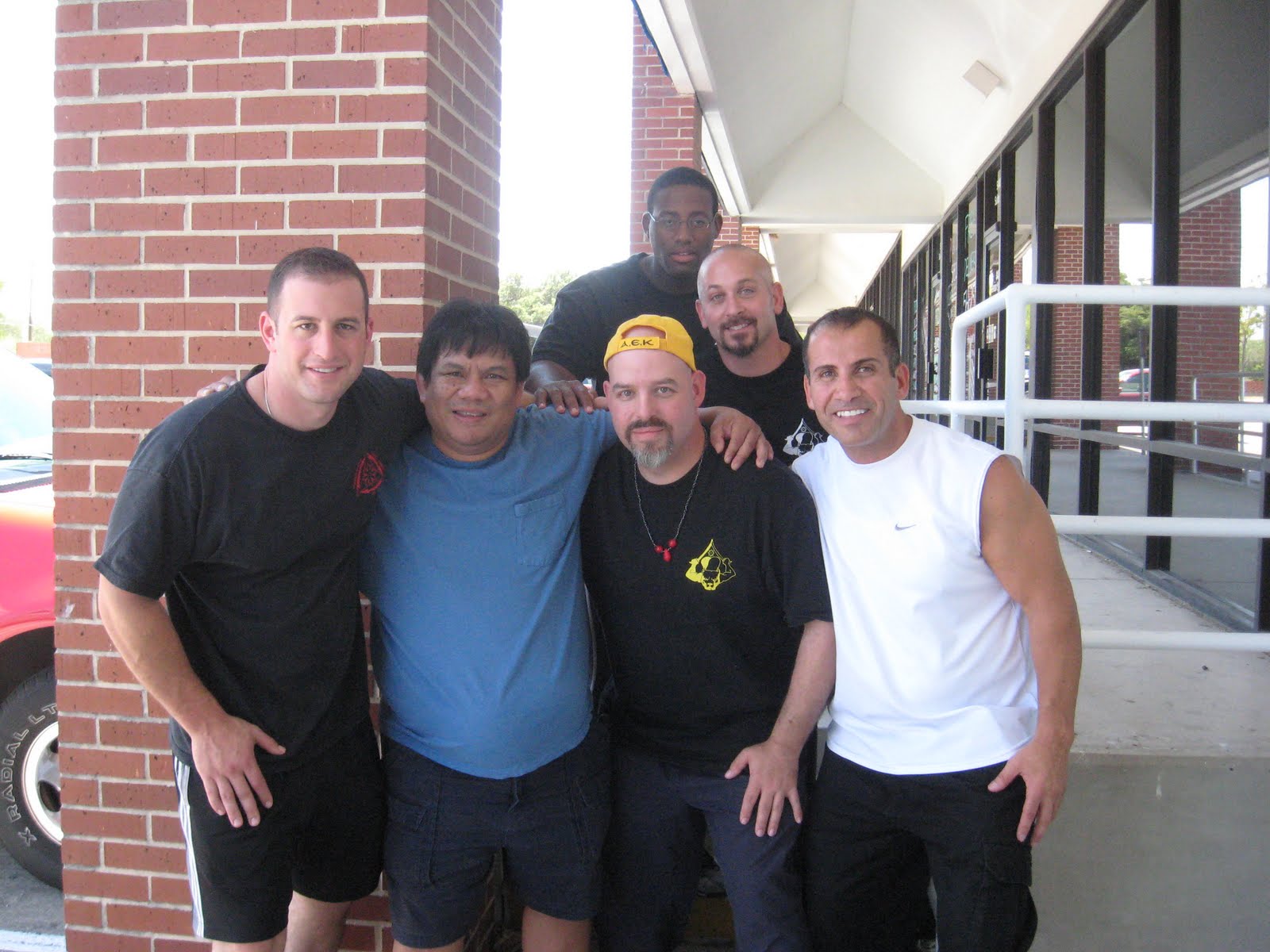
Yes, Rochester was where it all started. Where the three great minds and practitioners in FMA Pekiti in particular formally met. Doug Marcaida of Rochester, Jeff Davidson of Michigan and Jay Saludo of Saskatchewan Canada who got together and later founded and formed the formidable "Brotherhood of the Blade". Rochester was also the place where the exposure of a knife style that was, as Jeff always say "honed and proven on the streets of Lipa City, Batangas" in which later on was baptized by Jay as the "Barako Batangueno Knife" in honor of the handful of men called "Barakos" of Lipa City, Batangas.

The Barako knife as mentioned was first informally shown and introduced to Jeff Davidson which I recall started in a hallway then to a dimly lit room adjacent to the seminar. The meeting was short and sweet which was ended with a small talk about the style to the rest of the Detroit boys Bassam, Little Damon, Dean, Jeff D. and Jay M. It was a year later in Detroit that Barako was introduced to Doug Marcaida and the rest was history.

Barako is not for eveybody it is not a martial art or a system. Yours truly is not even a martial artist.

In Barako there is no such thing as rankings. Barako knife did not exist in the public eye till it's exposure 6 years ago in Rochester. However, there was a knife style exclusive to a handful of individuals (seven to be precise) honed on the streets of Lipa Batangas that started 46 years ago.

Saying so, in RECOGNITION of the individuals who embraced
Barako, Jay and I decided to honor such individuals by presenting them with full certification of instructorship in Barako Batangueno. The current and only recipients are Jeff Davidson, Doug Marcaida and upcoming Ed P. of Saskatchewan. For now Jeff and Doug are the only one's who has the authority to certify an associate trainer whom they see fit in the style. Most likely there will be one more individual in the very near future for full certification but that would be more of Jay's choosing. It would involve the old barakos with a slight taste of something fresh.

In closing, to Jeff thanks again and to the others (Doug and Jay) all responsible for the evolution, growth and propigation of Barako knife on what it was before and what it is (still) now however small, raw and un-orthodox it may be.

Tito Jun