We have officially begun the registration for the Silat Kuntau Tekpi classes! The first batch of membership kits are already spoken for, and more are on the way. Please everyone, I would like to start as many of you together as possible - so get on board now. The first "seminar" will be in mid-July, and we have several out-of-state guests who will be joining us on this journey.
Many of you have asked me how training in the Tekpi system will compliment your Pekiti Tirsia practice. Let me say that the two are absolutely blendable. First of all, Cigku Omar is one of the finest Pekiti Tirsia teachers/practitioners in the world. In fact, he is the mentor of MY mentor, Guro Doug Marcaida, whom you all know and respect. The majority of the people who are already studying Tekpi in the United States also have extensive backgrounds in Pekiti, so you're all in good company.
One great example of how Silat Kuntau Tekpi can be used with Pekiti is entries off the knife-tapping drill. Typically when your partner feeds, you guide out the knife, shock him with the '3d' hand and then either execute a quick throw or range out. Now, you have at the very LEAST 42 options from the Tekpi buahs - locks, throws, takedowns and neckbreaks -to apply as finishers. If you want to make the game more intersting and have the feeder try to counter the finsiher, you can even flow along with that! Tekpi has its own version of what we call "lock-flow" only its the entire body thats locked, not just the wrist or arm.
Many of you, such as Darryl and Arun, have already been on the receiving end of these locks and you know first hand how dangerous they are. This is why Cigku Omar has included an insurance policy with each membership.
As I have already said in class, Tekpi and Pekiti will be taught separately. We have a full Kali training schedule during the week, and so we have decided to take several days a month to devote exclusively to Tekpi so as not to break the flow - if you will - of the Kali class. But keep in mind that the two Arts while learned separately may be practiced together. Take it from me, after you learn these techniques, your Pekiti will never be the same (and I mean that in a good way!)
Speaking of practicing, I am very pleased that many of you are forming your own study groups outside of class to train. Remember, your time in class with me is meant for learning new material, and for the correction of any mistakes. Practice time is what you put in at home! In other words, if you learn something new on Monday, go home and practice it as much as possible before the next class so that when I see you again, we can take it to the next level instead of having to relearn it.
One last point...we have a very promising crop of beginning students. You guys are very talented, and are learning quickly, but keep in mind that under no circumstances are you permitted to TEACH! You want to show your girlfriend some self-defense techniques? Fine. You want to show your brother how to swing the stick at you so that you can drill your footwork? Ok. But don't ever take it upon yourselves to instruct another beginner or even make corrections during training. We have several instructors at every class. You know who they are by now. They have earned permission to teach for a reason! If someone has a question about a technique, ask a teacher! If the teacher doesn't know, he'll ask me; if I don't know, I'll ask Tuhon Gaje; if he doesn't know, chances are nobody does...
That's what we call the Chain of Command, folks.

Welcome to THE BALISONG JOURNAL An online journal of Southeast Asian Martial Arts, Culture and Spirituality from Guro Jeff Davidson and Detroit Kali-Silat. We will focus on Filipino Kali, Batangas Knife, and Silat Melayu (especially Silat Kuntau Tekpi) - along with Yoruba (West African) fighting and healing arts- and other interesting diversions along the way.
Tuesday, June 28, 2005


Tuesday, June 21, 2005
Silat Kingpins Interview
I've had several requests for copies of this interview conducted by Ustaz Hussein in the currently under-construction section of his website. So, with his kind permission I reproduce it here.
RCAG Interview with Guro Jeff Davidson of Pekiti Tirsia
RCAG: Salam Aleykum Guro
Guro Jeff: Aleykum Salam
RCAG: Guro, thank you for taking the time to have this interview with us.
RCAG: Guro Jeff, please tell us what exactly led you to the path of the
Silat Arts?
Guro Jeff: Initially, I was attracted to the "exotic-ness" of it all. I actually
began my journey into the Southeast Asian fighting disciplines with
Pangasinese Escrima after almost 10 years of practicing Chinese, Japanese
and Korean martial arts. I was searching for the roots of the empty-handed
system that would compliment my weapons training. Silat fascinated me -
especially the "internal aspect." I remember thinking: "This is so beyond
me, I will probably never get good at this. If I can only LEARN it, that
would be enough."
RCAG: What reason or reasons made you decide to change paths and join the
Pekiti Tirsia organization?
I have not changed paths at all! I am still powerfully focused on developing
myself to the best of my ability, and providing the highest standard of
training for those who study with me. This has always been my motivation
since the earliest days of my involvement in the martial arts. I believe
that one's first responsibility is to himself - in terms of growth. When one
reaches a certain level of comfort in his practice, it usually means he is
no longer being challenged. Progress in the martial arts is based onchallenge. A Master may not feel the need to accept challenges from other
fighters, but you cannot avoid your own need to grow, and leave your comfort
zone. This does not mean you need to learn a new batch of techniques! It
means you must seek out that which will push you to the next level. In my
case, Supreme Grand Tuhon Gaje "pushed" me farther during a single sparring
session than I had been in approximately 10 years!
RCAG: What are some combative principles of Pekiti Tirsia?
Pekiti Tirsia as we know it, is developed and refined by Supreme Grand Tuhon
Leo T. Gaje, who is connected to the realities of combat in a way most
people who do not live in a war zone ever will be. He has not only survived
the violent circumstances of his past, but he has elevated his skill to an
almost unbelievable level, which is acknowledged by his peers, supporters,
and even detractors. And he is still in the war zone to this day. I would
say that the principles of Pekiti Tirsia are a virtual 'Bible' of combat
against multiple, armed opponents - based on real-life encounters. The
techniques of Pekiti Tirsia (especially the way Tuhon is teaching them now)
represent the most effective and efficient means of applying those
principles. In almost 20 years of teaching martial arts, I have never seen
a system produce deadlier fighters in as short a period of time as Pekiti
Tirsia.
RCAG: What if anything is your speciality in the system i.e. knife, sword
etc.
I think it is important NOT to specialize in a particular weapon or
technique, as this can make you over-developed in some aspects of the Art
and under-developed in others. When I studied music in high school, I used
to sneak into clubs (being under aged) to take in the local music scene. I
remember being quite taken with a particular guitarist, who played with an
amazing virtuosity in several musical genres - jazz, rock, country, blues,
etc. I approached him after a performance and asked him: "Are you a jazz
player? Or a rock player? Or a blues player?" He chuckled and said "Nah,
kid...I'm just a player." In my opinion, just because you have a certain
proclivity towards say, the blade - you run the risk of being skillful with
that weapon, without really understanding the principles of combat in the
larger sense. That being said, my favorite weapon is the knife; my first
choice in an actual fight would be the stick; against multiple opponents I
would choose the staff; and I have the most "fun" with dumog and pangamut.
RCAG: Could you please tell us some more about Grandtuhon Leo Gaje. What
type of individual is he?
There is a veritable mythology that has developed in this country
surrounding Grand Tuhon Gaje. He is quite possibly the deadliest man on
Earth, in my opinion. In a word, inscrutable. There is no one I have seen
who can match him in terms of strength, tenacity, toughness - and sheer
relentlessness in combat. He really is a human pitbull! What's more, he has
the most advanced training methods to develop realistic fighting skills that
I have experienced. He is a genius - and not just in the realm of martial
arts. On the other hand, he is extremely kind, compassionate, humorous, and
a true Gentleman of the old school. This is the side of him that is often
overshadowed by his martial prowess in the eyes of the public - but the side
that is most appreciated by my own students. I like to think of him as
something of a cross between the battle-hardened veteran elite soldier, and
the kind, wise Grandfather. Which is what a Master should be!
RCAG: How do you think of Pekiti Tirsia in comparison to the Cimande arts
you practiced before?
Insofar as there are hundreds of "dialects" of Cimande, I am speaking here
only of the Cimande which I have had direct personal experience. And, since
I was given a "Master" ranking in that system, I believe I am well qualified
to offer an informed opinion! The Cimande I studied previously was very
'feminine', highly stylized, and in the extreme - somewhat contrived. Over
the years, whenever a law-enforcement or military man would come to study
with me, I found that I would have to teach a heavily modified form of
Cimande to suit their particular needs. Well, when you take out the frills,
you're left with a stripped-down version of Kali. So I feel, that Pekiti
Tirsia is the ULTIMATE in terms of combat practicality bar-none. Let me
give you an analogy: one of my Cimande teachers used to say that [the Art]
should resemble a keris. Well, a Javanese keris is aesthetically beautiful,
possessed of a certain mystical quality, and is essentially an object d'art
which would definitely NOT be your first choice on the battlefield. On the
other hand, a Filipino keris is far less ornate, but you can clear brush
with it; slaughter an ox, cut the main support beam for your house (or
kampong) and STILL cleave your opponents to pieces with it. In fairness, I
will say that Bapak Willem DeThouars of Colorado has the most combative
expression of Cimande that I have seen in this country. His Cimande is very
direct and explosive. When I met him in 1998, I commented on his lack of
flowery movement, to which he dryly replied "If I want to dance, I'll put on
my Benny Goodman records." God Bless him. At the time, he gave me some
very sound and well-intended guidance that I was not ready to accept. He
turned out to be right about everything he said. I still teach those
aspects of Silat which are consistent with my current goals in training,
which are essentially the metaphysical and healing aspects.
RCAG: Do you include firearms as part of your training curriculum? why orwhy not?
Yes! Although we do not yet have the facility or required licenses to
teach firearms on a group level, I strongly encourage firearms training,
because it is the basis of warfare in our modern times. To me, someone who
has developed tactical skill with the pistol and shotgun has more of a right
to call himself a martial artist than one who puts on a Gi twice a week
and does kata with antique farm implements.
RCAG: Do you think you being a Muslim changes your understanding of the
spiritual and cultural practices of Silat?
In retrospect, what has always impressed me most about the Indonesian Silat
masters that I have met is their faith in God, and how their Silat practice
is an expression of that faith. I have yet to meet an American who is on
that level. Most Americans are more interested in using the spiritual
aspects of Silat as a tool to obtain wealth, power, and control over others
through "occult" means, than they are in finding God through their
discipline. Sheikhs and pious teachers have strongly warned us for hundreds
of years against this type of mentality. Americans will have to learn this
FIRST before they can ever hope to understand real Silat. Martial arts
should be a path to finding your Higher Self, and to bind that Self to the
Lord of All Worlds - not to bind you to your own nafs. I feel that the idea
of connection and striving for the Divine has been lost in the rank-and-file
Far Eastern martial arts for a long time, and it is certainly foreign to the
modern American mindset. As a healer, I have to say to God: "I have no
power except that which You give me. Only You can heal this person. I am
only Your channel, if You will it." Well, all martial arts is about
healing! When someone comes to study with you, even though they THINK they
want to learn to fight, they are coming to you for HEALING. It could be
from the pain of low self-esteem; the pain of abuse; feelings of
helplessness; they may be filled with unchanneled anger and aggression; etc.
Modern science calls those 'behavioral' or 'mental' issues. But that type
of pain is rooted in the Soul - which is seeking to become whole. Only a
Sheikh can heal the Soul. And God is the source of all healing.
RCAG: Thank You so much for your time Guro Jeff!
Guro Jeff: Welcome. Salam Alaykum
RCAG: Wasalam Guro
RCAG Interview with Guro Jeff Davidson of Pekiti Tirsia
RCAG: Salam Aleykum Guro
Guro Jeff: Aleykum Salam
RCAG: Guro, thank you for taking the time to have this interview with us.
RCAG: Guro Jeff, please tell us what exactly led you to the path of the
Silat Arts?
Guro Jeff: Initially, I was attracted to the "exotic-ness" of it all. I actually
began my journey into the Southeast Asian fighting disciplines with
Pangasinese Escrima after almost 10 years of practicing Chinese, Japanese
and Korean martial arts. I was searching for the roots of the empty-handed
system that would compliment my weapons training. Silat fascinated me -
especially the "internal aspect." I remember thinking: "This is so beyond
me, I will probably never get good at this. If I can only LEARN it, that
would be enough."
RCAG: What reason or reasons made you decide to change paths and join the
Pekiti Tirsia organization?
I have not changed paths at all! I am still powerfully focused on developing
myself to the best of my ability, and providing the highest standard of
training for those who study with me. This has always been my motivation
since the earliest days of my involvement in the martial arts. I believe
that one's first responsibility is to himself - in terms of growth. When one
reaches a certain level of comfort in his practice, it usually means he is
no longer being challenged. Progress in the martial arts is based onchallenge. A Master may not feel the need to accept challenges from other
fighters, but you cannot avoid your own need to grow, and leave your comfort
zone. This does not mean you need to learn a new batch of techniques! It
means you must seek out that which will push you to the next level. In my
case, Supreme Grand Tuhon Gaje "pushed" me farther during a single sparring
session than I had been in approximately 10 years!
RCAG: What are some combative principles of Pekiti Tirsia?
Pekiti Tirsia as we know it, is developed and refined by Supreme Grand Tuhon
Leo T. Gaje, who is connected to the realities of combat in a way most
people who do not live in a war zone ever will be. He has not only survived
the violent circumstances of his past, but he has elevated his skill to an
almost unbelievable level, which is acknowledged by his peers, supporters,
and even detractors. And he is still in the war zone to this day. I would
say that the principles of Pekiti Tirsia are a virtual 'Bible' of combat
against multiple, armed opponents - based on real-life encounters. The
techniques of Pekiti Tirsia (especially the way Tuhon is teaching them now)
represent the most effective and efficient means of applying those
principles. In almost 20 years of teaching martial arts, I have never seen
a system produce deadlier fighters in as short a period of time as Pekiti
Tirsia.
RCAG: What if anything is your speciality in the system i.e. knife, sword
etc.
I think it is important NOT to specialize in a particular weapon or
technique, as this can make you over-developed in some aspects of the Art
and under-developed in others. When I studied music in high school, I used
to sneak into clubs (being under aged) to take in the local music scene. I
remember being quite taken with a particular guitarist, who played with an
amazing virtuosity in several musical genres - jazz, rock, country, blues,
etc. I approached him after a performance and asked him: "Are you a jazz
player? Or a rock player? Or a blues player?" He chuckled and said "Nah,
kid...I'm just a player." In my opinion, just because you have a certain
proclivity towards say, the blade - you run the risk of being skillful with
that weapon, without really understanding the principles of combat in the
larger sense. That being said, my favorite weapon is the knife; my first
choice in an actual fight would be the stick; against multiple opponents I
would choose the staff; and I have the most "fun" with dumog and pangamut.
RCAG: Could you please tell us some more about Grandtuhon Leo Gaje. What
type of individual is he?
There is a veritable mythology that has developed in this country
surrounding Grand Tuhon Gaje. He is quite possibly the deadliest man on
Earth, in my opinion. In a word, inscrutable. There is no one I have seen
who can match him in terms of strength, tenacity, toughness - and sheer
relentlessness in combat. He really is a human pitbull! What's more, he has
the most advanced training methods to develop realistic fighting skills that
I have experienced. He is a genius - and not just in the realm of martial
arts. On the other hand, he is extremely kind, compassionate, humorous, and
a true Gentleman of the old school. This is the side of him that is often
overshadowed by his martial prowess in the eyes of the public - but the side
that is most appreciated by my own students. I like to think of him as
something of a cross between the battle-hardened veteran elite soldier, and
the kind, wise Grandfather. Which is what a Master should be!
RCAG: How do you think of Pekiti Tirsia in comparison to the Cimande arts
you practiced before?
Insofar as there are hundreds of "dialects" of Cimande, I am speaking here
only of the Cimande which I have had direct personal experience. And, since
I was given a "Master" ranking in that system, I believe I am well qualified
to offer an informed opinion! The Cimande I studied previously was very
'feminine', highly stylized, and in the extreme - somewhat contrived. Over
the years, whenever a law-enforcement or military man would come to study
with me, I found that I would have to teach a heavily modified form of
Cimande to suit their particular needs. Well, when you take out the frills,
you're left with a stripped-down version of Kali. So I feel, that Pekiti
Tirsia is the ULTIMATE in terms of combat practicality bar-none. Let me
give you an analogy: one of my Cimande teachers used to say that [the Art]
should resemble a keris. Well, a Javanese keris is aesthetically beautiful,
possessed of a certain mystical quality, and is essentially an object d'art
which would definitely NOT be your first choice on the battlefield. On the
other hand, a Filipino keris is far less ornate, but you can clear brush
with it; slaughter an ox, cut the main support beam for your house (or
kampong) and STILL cleave your opponents to pieces with it. In fairness, I
will say that Bapak Willem DeThouars of Colorado has the most combative
expression of Cimande that I have seen in this country. His Cimande is very
direct and explosive. When I met him in 1998, I commented on his lack of
flowery movement, to which he dryly replied "If I want to dance, I'll put on
my Benny Goodman records." God Bless him. At the time, he gave me some
very sound and well-intended guidance that I was not ready to accept. He
turned out to be right about everything he said. I still teach those
aspects of Silat which are consistent with my current goals in training,
which are essentially the metaphysical and healing aspects.
RCAG: Do you include firearms as part of your training curriculum? why orwhy not?
Yes! Although we do not yet have the facility or required licenses to
teach firearms on a group level, I strongly encourage firearms training,
because it is the basis of warfare in our modern times. To me, someone who
has developed tactical skill with the pistol and shotgun has more of a right
to call himself a martial artist than one who puts on a Gi twice a week
and does kata with antique farm implements.
RCAG: Do you think you being a Muslim changes your understanding of the
spiritual and cultural practices of Silat?
In retrospect, what has always impressed me most about the Indonesian Silat
masters that I have met is their faith in God, and how their Silat practice
is an expression of that faith. I have yet to meet an American who is on
that level. Most Americans are more interested in using the spiritual
aspects of Silat as a tool to obtain wealth, power, and control over others
through "occult" means, than they are in finding God through their
discipline. Sheikhs and pious teachers have strongly warned us for hundreds
of years against this type of mentality. Americans will have to learn this
FIRST before they can ever hope to understand real Silat. Martial arts
should be a path to finding your Higher Self, and to bind that Self to the
Lord of All Worlds - not to bind you to your own nafs. I feel that the idea
of connection and striving for the Divine has been lost in the rank-and-file
Far Eastern martial arts for a long time, and it is certainly foreign to the
modern American mindset. As a healer, I have to say to God: "I have no
power except that which You give me. Only You can heal this person. I am
only Your channel, if You will it." Well, all martial arts is about
healing! When someone comes to study with you, even though they THINK they
want to learn to fight, they are coming to you for HEALING. It could be
from the pain of low self-esteem; the pain of abuse; feelings of
helplessness; they may be filled with unchanneled anger and aggression; etc.
Modern science calls those 'behavioral' or 'mental' issues. But that type
of pain is rooted in the Soul - which is seeking to become whole. Only a
Sheikh can heal the Soul. And God is the source of all healing.
RCAG: Thank You so much for your time Guro Jeff!
Guro Jeff: Welcome. Salam Alaykum
RCAG: Wasalam Guro
Friday, June 17, 2005
Update: Interview with Ka Uli
There's a great interview with Ka Uli by a European martial arts magazine on www.pekiti-tirsia.net.
Here's the link:
Here's the link:
INTERVIEW WITH ULI WEIDLE Thursday, June 09, 2005
A Feather in Our Cap
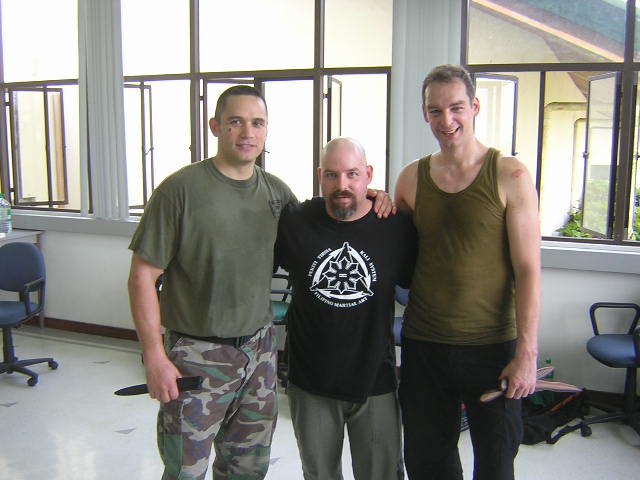
Jeff with Ka Uli Weidle and Jared Wihongi
Jared is a member and tactical combat instructor for Salt Lake City, Utah SWAT
Grand Tuhon Gaje has just returned from a furious schedule of seminars and workshops in Europe conducted over the past month. The coordinator/director of Pekiti Tirsia in Europe is Maginoo Mandala Uli Weidle of Germany - whom I had the pleasure of training with during the Balikatan of 2005 in the Philippines.
In addition to running perhaps the largest Pekiti Tirsia school in the world, Ka Uli promotes the Art all over Europe. Currently there are Pekiti Tirsia schools in Germany, Spain, Sweden, the Czech Republic, Austria and Finland - and soon Romania. Ka Uli is also a tactical instructor for the elite German and Austrian SWAT/Counter-Terrorism forces.
There can be no better endorsement of the effectiveness of Pekiti Tirsia and Grand Tuhon Gaje that so many world governments (including the United States) are clamoring to include this great system as part of their Homeland Defense. They recognize that Pekiti is as pragmatic on the “State” level as it is on the personal level when it comes to the defense of life and liberty.
While in the Philippines, I asked Sgt. Balthazar and several members of the 63d Battalion Force Recon Marines just how many of their encounters with enemy forces in the south necessitated the use of bladed weapons. The 63d Battalion sees more action in the southern Philippines than perhaps any other unit. They are lean, intense, and to a man have a 1000 yard stare that goes through you like an icy wind. Sgt. Balthazar enthusiastically replied to my question: “We have many, many fights against them with our bolos...and we always win because of the training Tuhon Gaje has given us!” Sgt. Balthazar is pound-for-pound one of the toughest human beings on two legs. He took a liking to my student Dean Hadin, and even presented him with a barong that had been “recovered” while on operations in Jolo.
Getting back to Maginoo Mandala Uli Weidle, he has a most unassuming demeanor for someone of his considerable skill level. I commented on that very fact to him, and he said reflectively: “In my experience with martial arts people, the more you claim to be, the less you really are.” How very true indeed.
Uli's website is www.pekiti-tirsia.net
Tuesday, June 07, 2005
Biblical Linguistics
Anyone attempting to fathom the mysteries of a particular culture had best start with a clear grasp of the linguistics. Here is but a scratch of the surface - sent to me by a friend. Next time the Jehovah's Witnesses come to your door...hit 'em with this.
The Mystery Of The Bio-Genetic Coding Re-Genesis Of The Two Abrahamic Seed Strains.
The Right Vocalization Of The Hebrew Bible: In Hebrew, as in Arabic, there are no real vowels in the alphabet, and vocalization can only be indicated by vowel signs. With different vocalizations, words spelled in the same way can yield widely different meanings. One well-known example comes from the story of the "ravens"
that brought ". . . bread and flesh in the morning, and bread and fleshin the evening" to the prophet Elijah while he was hiding himself near the brook of Cherith (1kings 17:6). In vocalizing the original Hebrew of this story, the Masoretes rendered the word 'rbym as 'orbim, which produced the meaning "ravens". Had they rendered it as 'arbim, as some Biblical scholars have suggested, it would have meant 'Arabs', which makes better sense as far as the story goes.
When working with the scripture a person should derive their insights using a variety of devices, such as puns, anagrams, gematria (letter manipulations) and cross references to the same word in different contexts and other languages in order to
decode the biblical mysteries. Another example of the mishaps that can result in vowel vocalization, and therefore translation, is the word "Kabbalah". There are many alternative spellings of the word, the two most common being Kabbalah and Qabalah. Cabala,Qaballah, Qabala, Kaballah (and so on) are also seen. The reason for this is that some letters in the Aramaic and Hebrew alphabet have more than one corresponding representation in the English alphabet, thus rendering the same Hebrew letter as either K or Q (or sometimes even C).
Also the words:
Qumran, Umran, Amran, 'Imran.
The etymology of the names can also reveal the many teachings hidden in the stories of the scriptures. In Genesis 17:5, 'Abraham' ('brhm, parsed 'b rhm) is taken to mean 'father of multitude'. In Genesis, Sarai (sry), whose name means simply 'lady'.
In idiomatic Arabic 'lady' is the standard way to refer to a 'grandmother', or 'ancestress'. Thus, so to speak, Abram, personifying the 'ancestor', was married to Sarai, personifying the 'ancestress'.
It should be noted that in Genesis 17 when the name of Abram was changed into ''Abraham'' the change in name by adding h to the name ''The brith''.
The name change carries many keys to the mystery of Abraham. The mystery of adding the 'h' is the start of the bio-genetic coding re-genesis of ''two'' different strains in correspondences with the 12 matrix Archetypal forms controled
by
''The 12 matrixes of the Zodiac.''
Jacob name was also changed from Jacob to Israel, the name 'Is-ra-el' carries a spiritual precept concerning the true nature of the genatic coding program of the Abrahmic seed: Is - (The Female Earth Archetype ''Isis'')
Ra- (The Solar Archetypal Correspondences)
El - (The Infinite Spirit ''Elohims'')
The name Ismael Abraham from Hagar of Egyptian carries the genatic coding program of the Abrahmic seed:
Is - (The Female Earth Archetype ''Isis'')
Ma- (the Lunar Archetypal Correspondances)
El - (the Infinite Spirit ''Elohims'')
Another point of significance is that
the two
names
of
ISRAEL & ISMAEL
has
only one letter change
the
''RA'' & ''MA''
which embodies the change of:
Elements
of
FIRE & AIR
or
Sun & Moon
.
It should be noted that the two names, Israel & Ismael are poles in the mystery of the bio-genetic coding of the re-genesis of the two strains of one seed in correspondence with the same 12 matrix Archetypal forms which fall under
the control of the 12 matrixes of the Zodiac. Each of the 12 matrixes is also interrelated with the original three archetypes of Earth or Nature as well as the
Eight Primordial Universal Archetypes
According to Cornine Heline's 'New Age Bible Interpretation, New Testament, Volume V. The twelve tribes of Israel in correlation with the Zodiac:
Aries: Tribe of Dan
Taurus: Tribe of Benjamin
Gemini: Tribe of Manasseh
Cancer: Tribe of Ephraim
Leo: Tribe of Judah
Virgo: Tribe of Reuben
Libra: Tribe of NaphtaliScorpio: Tribe of Asher
Sagittarius: Tribe of Gad
Capricorn: Tribe of Zebulun
Aquarius: Tribe of Issachar
Pisces: Tribe of Simeon
The Mystery Of The Bio-Genetic Coding Re-Genesis Of The Two Abrahamic Seed Strains.
The Right Vocalization Of The Hebrew Bible: In Hebrew, as in Arabic, there are no real vowels in the alphabet, and vocalization can only be indicated by vowel signs. With different vocalizations, words spelled in the same way can yield widely different meanings. One well-known example comes from the story of the "ravens"
that brought ". . . bread and flesh in the morning, and bread and fleshin the evening" to the prophet Elijah while he was hiding himself near the brook of Cherith (1kings 17:6). In vocalizing the original Hebrew of this story, the Masoretes rendered the word 'rbym as 'orbim, which produced the meaning "ravens". Had they rendered it as 'arbim, as some Biblical scholars have suggested, it would have meant 'Arabs', which makes better sense as far as the story goes.
When working with the scripture a person should derive their insights using a variety of devices, such as puns, anagrams, gematria (letter manipulations) and cross references to the same word in different contexts and other languages in order to
decode the biblical mysteries. Another example of the mishaps that can result in vowel vocalization, and therefore translation, is the word "Kabbalah". There are many alternative spellings of the word, the two most common being Kabbalah and Qabalah. Cabala,Qaballah, Qabala, Kaballah (and so on) are also seen. The reason for this is that some letters in the Aramaic and Hebrew alphabet have more than one corresponding representation in the English alphabet, thus rendering the same Hebrew letter as either K or Q (or sometimes even C).
Also the words:
Qumran, Umran, Amran, 'Imran.
The etymology of the names can also reveal the many teachings hidden in the stories of the scriptures. In Genesis 17:5, 'Abraham' ('brhm, parsed 'b rhm) is taken to mean 'father of multitude'. In Genesis, Sarai (sry), whose name means simply 'lady'.
In idiomatic Arabic 'lady' is the standard way to refer to a 'grandmother', or 'ancestress'. Thus, so to speak, Abram, personifying the 'ancestor', was married to Sarai, personifying the 'ancestress'.
It should be noted that in Genesis 17 when the name of Abram was changed into ''Abraham'' the change in name by adding h to the name ''The brith''.
The name change carries many keys to the mystery of Abraham. The mystery of adding the 'h' is the start of the bio-genetic coding re-genesis of ''two'' different strains in correspondences with the 12 matrix Archetypal forms controled
by
''The 12 matrixes of the Zodiac.''
Jacob name was also changed from Jacob to Israel, the name 'Is-ra-el' carries a spiritual precept concerning the true nature of the genatic coding program of the Abrahmic seed: Is - (The Female Earth Archetype ''Isis'')
Ra- (The Solar Archetypal Correspondences)
El - (The Infinite Spirit ''Elohims'')
The name Ismael Abraham from Hagar of Egyptian carries the genatic coding program of the Abrahmic seed:
Is - (The Female Earth Archetype ''Isis'')
Ma- (the Lunar Archetypal Correspondances)
El - (the Infinite Spirit ''Elohims'')
Another point of significance is that
the two
names
of
ISRAEL & ISMAEL
has
only one letter change
the
''RA'' & ''MA''
which embodies the change of:
Elements
of
FIRE & AIR
or
Sun & Moon
.
It should be noted that the two names, Israel & Ismael are poles in the mystery of the bio-genetic coding of the re-genesis of the two strains of one seed in correspondence with the same 12 matrix Archetypal forms which fall under
the control of the 12 matrixes of the Zodiac. Each of the 12 matrixes is also interrelated with the original three archetypes of Earth or Nature as well as the
Eight Primordial Universal Archetypes
According to Cornine Heline's 'New Age Bible Interpretation, New Testament, Volume V. The twelve tribes of Israel in correlation with the Zodiac:
Aries: Tribe of Dan
Taurus: Tribe of Benjamin
Gemini: Tribe of Manasseh
Cancer: Tribe of Ephraim
Leo: Tribe of Judah
Virgo: Tribe of Reuben
Libra: Tribe of NaphtaliScorpio: Tribe of Asher
Sagittarius: Tribe of Gad
Capricorn: Tribe of Zebulun
Aquarius: Tribe of Issachar
Pisces: Tribe of Simeon
Monday, May 30, 2005
MAILBAG
I get a lot of emails every week from different parts of the country. I try my best to answer questions with a line or two of response - but time is at a premium these days, so I thought I would post answers to the most frequently asked questions here. The questions are in itallics, my responses are in standard face type.
What is ‘Maphilindo?’ Is it different from Pekiti? Is it the same as Dan Inosanto’s blend of Silat?
We are a Pekiti Tirsia group first and foremost. Tuhon Gaje gave us the appellation “Maphilindo Pitbulls” as he has charged us with the responsibility of researching the Malaysian and Indonesian currents that flow with the Filipino fighting systems. It is not the Inosanto blend of Silat. The term ‘Maphilindo’ was coined in the ‘60's as the name of a pact (like NATO) of Southeast Asian nations.
Since you study directly with Tuhon Gaje, why do you seek out other teachers of Pekiti Tirsia to train with?
I am convinced that no one person has ever/can ever learn everything Tuhon Gaje has to teach. In my experience, Tuhon gives different “gifts” to different students, each according to his own ability. Training with other Pekiti Elders such as Doug Marcaida, Ricky Rillera, Robert Slomkowski, and Omar Hakim has helped me to understand and refine what Tuhon has given to me.
Are there any other systems of FMA that you recommend as a compliment to Pekiti Tirsia?
I am less concerned with systems and more concerned with teachers. In my opinion, one of the most remarkable FMA teachers I have had the pleasure of meeting is Guro Jun DeLeon of Toronto, Canada - who happens to be a close compadre of Tuhon Gaje. Guro Jun is simply the best FMA teacher I have seen in this part of the world . Even more impressive, every student of his that I have met is a top-notch technician.
What specific African martial arts have you studied? Can you tell me more about them? Where is this village of Ode Remo where you went to learn African martial arts?
I have studied Gidigbo and Jakadi. I am planning an in-depth article on West African martial arts in the near future...time permitting. The town of Ode Remo is in Ogun State, Southwest Nigeria near Sagamu. If you can’t find it on the map, look for ‘Ijebu Remo.’
I understand you work with oncology patients and maintain a natural healing practice. Can you recommend a cure/therapy for X?
No. I am not a licensed physician and therefore I do not diagnose, treat or prescribe medicines for any illness. Rather, I can suggest certain things that are historically documented (going back as far as Hakim Ibn Sina’s Cannon of Medicine) to assist in balancing the body’s natural energies toward restoring a state of balance. I also have a network of acupuncturists, chiropractors, and practitioners of complimentary healing modalities that I can make referrals to.
There are no Pekiti Tirsia teachers in my area...how should I best study this system?
You should find the nearest Pekiti group to you, and make arrangements to train at least once a month. There are few Pekiti teachers that I know who would not go out of their way to accommodate you. The more serious you demonstrate yourself to be, the more doors may open. Tim Waid at www.pt-go.com can help you locate someone close to you. Also, try to attend at least 2 Tuhon Gaje seminars per year.
Will you refer me to a martial arts/spiritual teacher in my area?
I will gladly make recommendations to instructors that have a public teaching practice. Please understand that I will not refer someone who I do not vouch for personally to a private teacher.
What is ‘Maphilindo?’ Is it different from Pekiti? Is it the same as Dan Inosanto’s blend of Silat?
We are a Pekiti Tirsia group first and foremost. Tuhon Gaje gave us the appellation “Maphilindo Pitbulls” as he has charged us with the responsibility of researching the Malaysian and Indonesian currents that flow with the Filipino fighting systems. It is not the Inosanto blend of Silat. The term ‘Maphilindo’ was coined in the ‘60's as the name of a pact (like NATO) of Southeast Asian nations.
Since you study directly with Tuhon Gaje, why do you seek out other teachers of Pekiti Tirsia to train with?
I am convinced that no one person has ever/can ever learn everything Tuhon Gaje has to teach. In my experience, Tuhon gives different “gifts” to different students, each according to his own ability. Training with other Pekiti Elders such as Doug Marcaida, Ricky Rillera, Robert Slomkowski, and Omar Hakim has helped me to understand and refine what Tuhon has given to me.
Are there any other systems of FMA that you recommend as a compliment to Pekiti Tirsia?
I am less concerned with systems and more concerned with teachers. In my opinion, one of the most remarkable FMA teachers I have had the pleasure of meeting is Guro Jun DeLeon of Toronto, Canada - who happens to be a close compadre of Tuhon Gaje. Guro Jun is simply the best FMA teacher I have seen in this part of the world . Even more impressive, every student of his that I have met is a top-notch technician.
What specific African martial arts have you studied? Can you tell me more about them? Where is this village of Ode Remo where you went to learn African martial arts?
I have studied Gidigbo and Jakadi. I am planning an in-depth article on West African martial arts in the near future...time permitting. The town of Ode Remo is in Ogun State, Southwest Nigeria near Sagamu. If you can’t find it on the map, look for ‘Ijebu Remo.’
I understand you work with oncology patients and maintain a natural healing practice. Can you recommend a cure/therapy for X?
No. I am not a licensed physician and therefore I do not diagnose, treat or prescribe medicines for any illness. Rather, I can suggest certain things that are historically documented (going back as far as Hakim Ibn Sina’s Cannon of Medicine) to assist in balancing the body’s natural energies toward restoring a state of balance. I also have a network of acupuncturists, chiropractors, and practitioners of complimentary healing modalities that I can make referrals to.
There are no Pekiti Tirsia teachers in my area...how should I best study this system?
You should find the nearest Pekiti group to you, and make arrangements to train at least once a month. There are few Pekiti teachers that I know who would not go out of their way to accommodate you. The more serious you demonstrate yourself to be, the more doors may open. Tim Waid at www.pt-go.com can help you locate someone close to you. Also, try to attend at least 2 Tuhon Gaje seminars per year.
Will you refer me to a martial arts/spiritual teacher in my area?
I will gladly make recommendations to instructors that have a public teaching practice. Please understand that I will not refer someone who I do not vouch for personally to a private teacher.
Tuesday, May 17, 2005
Memories from the Tekpi Camp
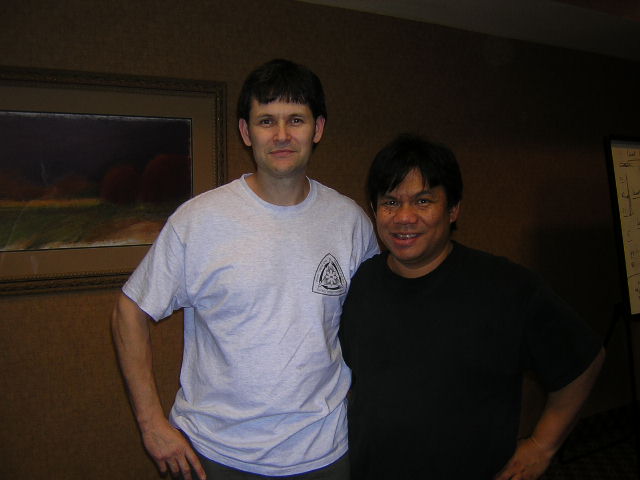
Robert and Ricky
My main training partner during the Silat Kuntau Tekpi (TM) camp was none other than the legendary Pekiti Tirsia fighting machine Ricky "The Flying Punyo" Rillera from San Antonio, Texas. There was nothing better after an exhausting day of Tekpi training than to drill Pekiti in the hotel parking lot with Ricky and Robert Slomkowski - another "old school" Pekiti veteran.
Both Robert and Ricky are gifted with an uncanny sense of broken rythmn, and are in-humanly explosive with strikes and footwork. Robert has some of the best empty-hand skills I've experienced from any fighter - Pekiti or otherwise. One session began with the unlikely premise that Greco-Roman wrestling tactics can be applied to Silat (I admit I didn't give him the benefit of the doubt on that one) and progressed to several spine-jarring, whiplashing hands-on examples that more than made a believer out of me.
Ricky is also a student of the natural healing arts, and has an uncommonly broad understanding of internal energy. He has made some great innovations to traditional herbal formulas based on his experience with Holistic medicines.
I'll see you Bros again soon!
MABUHAY
Friday, May 13, 2005
My Brother from Solo, Central Java
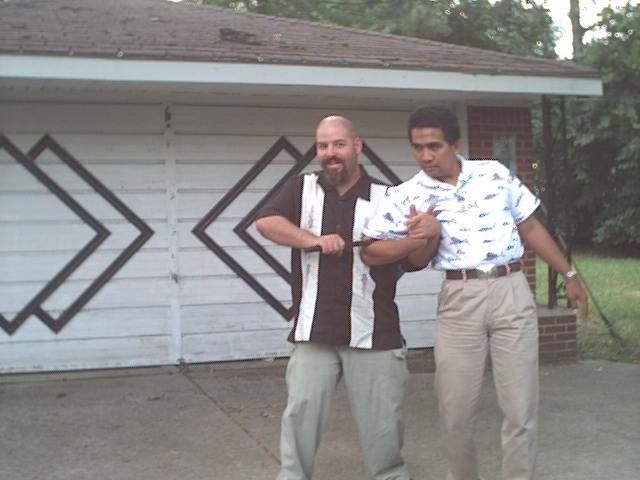
I have two homes. My physical body dwells and toils in a quiet suburban city about 20 minutes north of Detroit, Michigan. My "other" self - or soul if you will - has continued to seek refuge in its true abode in Solo City ever since "we" returned home there several years ago.
In August of 2004 we were honored by a visit from a man I consider to be my closest friend, and a true Brother, Bapak Reno Notohardjo. 'Pa Reno is currently a resident of the U.S. eastern seaboard, however he was born and raised in the Heartland of Kejawan culture - Solo City in Central Java.
Reno is a true son of his culture. I am convinced that there is no greater living example of the authentic Javanese "inner life" on American soil than this exceedingly humble individual. During his visit, 'Pa Reno graciously favored us with several lectures, expounding eloquently and concisely on some very esoteric and subtle material culled from sources such as the Quran, the Ramayana, and lore regarding the mysterious "Walisongo" - or 9 mystic saints creditied with bringing Islam/Sufism to the Inodnesian Archipelago - all in realtion to the traditional Central Javanese spiritual worldview.
I will always remember one evening's selametan in particular. My students and I were assembled in my living room after enjoying some truly delectable middle-eastern fare prepared by one of the finest Lebanese chefs in Dearborn at the behest of a local, very spiritually-inclined businessman who had come to us upon hearing that an Indonesain mystic had arrived for a visit.
Following the meal, we sat literally packed (yet comfortable) on carpets as tea was served and water-pipes of strong Syrian tobacco were lit. Another student - a musician - managed to locate my Mississippi Dobro and tune it like an oud. As he played over the din in the room, it felt rather like a scene from the Arabian Nights.
In any truly spiritual practice, there is a feeling that actual physical time is stopped. We all sat enraptured as 'Pa Reno began his dialogue with a particularly Indonesian explanation of a portion of the Indian epic Mahabarata as related to the practice of Southeast Asian martial arts.
Long into the night, after a typical Michigan summer "brown-out" necessitated the kindling of an oil lamp, I closed my eyes as 'Pa Reno broke into the melodious dialect of his magnificent Land, and for all too short a time...I was indeed back "home."
The talks were duly transcribed from our recordings - sufficient to capture the message if not the ambiance of those profound evenings. In time, and with the proper editing, I hope to publish them. God Willing.
We were also honored to share some training in Pekiti Tirsia with our guest (as evidenced in the photo above.) 'Pa Reno's family in Indonesia (specifically his brother Martin) is plugged into an extensive network of top Silat Masters from Java to Borneo - and was kind enough to make some very important contacts for me as he did for a French colleague of mine some years ago. My teacher, Grand Tuhon Leo T. Gaje Jr. has charged me with the task of further researching the currents from Indonesia and Malaysia which have contibuted to the beauty and, to use his expression "grandure" that is the Southeast Asian martial arts. I got some very important and tantilizing clues from Cigku Omar Hakim recently, and am currently planning a massive field research project in Southeast Asia for the summer. God Willing.
So, Brother Reno...thank you for years of fellowship and encouragement - including our talk this very evening. Our friendship will continue to bridge time, cities, states, and perhaps continents. God Willing.
JD
A Little More About Silat Kuntau Tekpi
I have had an enormous response from my students and the public regarding lessons in Silat Kuntau Tekpi (TM). I am just as excited to begin teaching it, and believe me, I am working as fast as I can to get everything in place for classes. I know that Cigku Omar is putting the finishing touches on the official website for the system, which exists in a temporary form at
http://tekpi.org/
Cigku Omar Hakim also has a blog where he relates some of his experiences in Malaysia. This can be found at
http://trsresearch.blogspot.com/
Here is a chokingly brief summary of the Art:
About Kuntau Silat Tekpi:
Seni Silat Kuntau Tekpi was founded by Panglima Taib (General Taib Bin Wan Hussein). He is the great-grandfather of the current head of the system, Cikgu Sani. The exact date of origin is unsure, but it appears to be around 1890.
The Tekpi itself, otherwise known as the sai, are central to the system, along with the keris (the wavy kris-like dagger). The logo of the system reveals much about its character:
Colors – The logo is made up of three colors: white, red, black. The White stands for purity and Islamic values. The Red stands for bravery & brotherhood. The Black stands for secrecy, for this has historically been a secret art.
Weapons - There are four weapons represented in the logo that are the weapons of Silat Kuntau Tekpi. The weapons are:
Rantai (Chain) - Two chains are shown with 13 links each. Each link symbolizes one of the 13 Federal States that make up the country of Malaysia.
Cindai (Cloth) - The word TEKPI is written on a long thin cloth sash called a cindai. The cindai is used in Malaysia as a belt or sash worn with traditional clothing.
Tekpi - The tekpi (a.k.a. sai) is the primary weapon of Kuntau Tekpi, giving the art its name. This is because the tekpi is not a Malay weapon - it is of Chinese origin, so it is considered unusual for a Malaysian form of Silat to use the tekpi.
Keris (Kris) - This is a 7 lok (wave) keris which is what is worn and used by the Malay Panglima (Generals). Seven waves is the most that a keris can have for someone who is not of royal blood. That's why Seni Silat Lok Sembilan (9) has a keris with 9 waves - it is a Royal form of Silat for Princes. The Keris of a Sultan can have up to 13 or 15 lok.
Tekpi is a compact, well-organized fighting system - it has five levels including the central 42 buah, or traditional forms, that define its movements.
http://tekpi.org/
Cigku Omar Hakim also has a blog where he relates some of his experiences in Malaysia. This can be found at
http://trsresearch.blogspot.com/
Here is a chokingly brief summary of the Art:
About Kuntau Silat Tekpi:
Seni Silat Kuntau Tekpi was founded by Panglima Taib (General Taib Bin Wan Hussein). He is the great-grandfather of the current head of the system, Cikgu Sani. The exact date of origin is unsure, but it appears to be around 1890.
The Tekpi itself, otherwise known as the sai, are central to the system, along with the keris (the wavy kris-like dagger). The logo of the system reveals much about its character:
Colors – The logo is made up of three colors: white, red, black. The White stands for purity and Islamic values. The Red stands for bravery & brotherhood. The Black stands for secrecy, for this has historically been a secret art.
Weapons - There are four weapons represented in the logo that are the weapons of Silat Kuntau Tekpi. The weapons are:
Rantai (Chain) - Two chains are shown with 13 links each. Each link symbolizes one of the 13 Federal States that make up the country of Malaysia.
Cindai (Cloth) - The word TEKPI is written on a long thin cloth sash called a cindai. The cindai is used in Malaysia as a belt or sash worn with traditional clothing.
Tekpi - The tekpi (a.k.a. sai) is the primary weapon of Kuntau Tekpi, giving the art its name. This is because the tekpi is not a Malay weapon - it is of Chinese origin, so it is considered unusual for a Malaysian form of Silat to use the tekpi.
Keris (Kris) - This is a 7 lok (wave) keris which is what is worn and used by the Malay Panglima (Generals). Seven waves is the most that a keris can have for someone who is not of royal blood. That's why Seni Silat Lok Sembilan (9) has a keris with 9 waves - it is a Royal form of Silat for Princes. The Keris of a Sultan can have up to 13 or 15 lok.
Tekpi is a compact, well-organized fighting system - it has five levels including the central 42 buah, or traditional forms, that define its movements.
Thursday, May 05, 2005
SILAT KUNTAU TEKPI CLASSES!!!!!!
On May 1, 2005 I completed the first "Instructor Candidate" certification course in the Malaysian martial art of Silat Kuntau Tekpi (TM) under the direction of Cigku Omar Hakim in Austin Texas. Stay tuned for more info on classes in the Detroit area in this unique Silat method.
Sunday, March 20, 2005
Interesting Article
Islam and African Traditional Religions
by Josef Stamer
Islam in Sub-Saharan Africa has known a thousand years of cohabitation with traditional religion and adaptation to it, even to the extent of intermixture. In many areas it has little-by-little substituted itself for it, without too many clashes or ruptures. Today this experience is rejected by a significant number of African Muslims, who instead turn consciously to the Arab model of living Islam, as they imagine it to have been instituted by the Prophet Muhamed and lived by the founding community in Medina. In Africa, perhaps more than elsewhere, the islamising tendency in whatever form it presents itself, is a challenge to an entire way of being, behaving and living in community - a challenge to the very roots of the African way. Can there still he a valid African way of being Muslim or not?
The mass adoption of Islam by the Africans is a relatively recent fact. It was preceded in most cases by a long period of co-existence during which Islam remained a minority religion. It was not the superiority of the religious message of the Koran that finally tipped the balance in Islam's favour but rather purely sociological factors which, as in the case of colonialism and the arrival of modern technology, were completely external and foreign to both spiritual universes.
Traditional African religion, aside from the disconcerting diversity of its actual forms of expression, is in reality much more than (those) in the west mean by the term «religion». It is a global framework of life, encompassing every human situation and governing the whole of society. It is closely linked to the ancestral soil and places each African both in the succession of the generations (the ancestors), in his relationship with his fellow creatures and in his productive activities. Everything is religious!
The direct relation with God is rarely explicit but the belief in one God, Who is Creator and Good, underlies everything else. God does not intervene in the day-to-day affairs of life. These are governed by other invisible forces, good or evil, from whom it is possible to win favours through the ritualised experience of the ancestors. Strict observation of the rites and taboos and total solidarity within the group are the best guarantee of group survival and the transmission of life to numerous descendants. Seen from the outside, constraint and fear seem to be the dominant notes of traditional African religion, but this would be to forget that it offers an overall framework of security in an often very hostile environment, where only the survival of the group ultimately counts.
In many regions of Africa Islam has gradually substituted itself for the traditional religion, sometimes under the influence of external factors and in the overwhelming majority of cases without any violence. One could cite a whole series of factors that show a degree of cultural and sociological proximity between these two religious worlds. But at the same time there are other respects, equally fundamental, in which the two religions seem irreconcilable. Ancestor worship, for example, is something fundamental to traditional religion if ever anything was, and yet it is completely foreign to Islam. The real proximity of Islam with traditional religion lies far more in the fact that both are more than a religion pure and simple, in the sense of one dealing solely with the relationship of man to the Spiritual.
And indeed, in all the difficulties of life for the African uprooted or disillusioned with his traditional socio-religious universe, Islam offers a new framework, as all-embracing, as secure and as reassuring as the old one. A new solidarity within the Muslim community replaces the village and tribal solidarities without changing the laws and habits of life of the group. New prescriptions and prohibitions replace the old ones, without the need to try and understand their deeper meaning. The only real novelty is the centralisation of the worship on God, especially in the ritual prayer. But this does not exclude other ritual practices from existing alongside - and for a long time - in order to appease the intermediate powers. African Islam has never expressly forbidden these. On the contrary, given the central place of the sacred Koranic text in Islam and the impossibility for most Africans of gaining direct access to it, since they do not know Arabic, the more or less qualified custodians of the Scriptures have themselves become the new intermediaries, sought out and feared, who replace the healers, the fetishists and the other members of the secret societies without which traditional religion could not function.
In the process of islamisation the primary motive is clearly the desire to belong to a community, far more than the interior assent to a new religious message. In this respect has demonstrated great flexibility and patience over the centuries. Gaining access to the Muslim community has always been very easy: a change of name and the recitation, before witnesses, of the profession of faith (shadâda). The regular fulfilment of the other religious duties and the deepening of religious knowledge will follow perhaps only a generation or two later. There is no real break in the passage from one community to the other, but simply a progressive disengagement from the one and a progressive integration into the other.
The long cohabitation of Islam with traditional African religion has also had an effect at the cultural level. The African languages are in general languages with a concrete vocabulary, rather limited in the expression of more abstract realities or more developed reflections. With the Arabic language Islam has been able to fill a gap. Many African peoples, some scarcely touched by Islam, have borrowed a complete abstract, and especially religious, vocabulary from Arabic, with no more than the changes proper to the structure of each language. The actual islamisation has come later, confirming and assembling within a coherent structure these scattered modes of thought and expression that were from Islam in the first place. Thus the inculturation of the religious message has in many cases preceded the islamisation itself
Islam was brought to Sub-Saharan Africa in the first place via the trade routes from the Arab countries and North Africa. The African Muslims have always maintained quite close links with the Arab world, from which a number of reformers came. But islamisation was essentially carried out by Africans themselves, who shared the same life, spoke the same language, lived in the same cultural world entirely. There is no doubt that, for African Muslims, «Africanicity» and Islam are in no way opposed. For them Islam is not an imported religion. For many, abandoning the Muslim religion is equivalent to the rejection of all their family and tribal traditions, so intermingled are the two socio-religious universes. One must conclude that Islam, in its traditional African form, is entirely a part of the African cultural heritage and thus an African reality.
by Josef Stamer
Islam in Sub-Saharan Africa has known a thousand years of cohabitation with traditional religion and adaptation to it, even to the extent of intermixture. In many areas it has little-by-little substituted itself for it, without too many clashes or ruptures. Today this experience is rejected by a significant number of African Muslims, who instead turn consciously to the Arab model of living Islam, as they imagine it to have been instituted by the Prophet Muhamed and lived by the founding community in Medina. In Africa, perhaps more than elsewhere, the islamising tendency in whatever form it presents itself, is a challenge to an entire way of being, behaving and living in community - a challenge to the very roots of the African way. Can there still he a valid African way of being Muslim or not?
The mass adoption of Islam by the Africans is a relatively recent fact. It was preceded in most cases by a long period of co-existence during which Islam remained a minority religion. It was not the superiority of the religious message of the Koran that finally tipped the balance in Islam's favour but rather purely sociological factors which, as in the case of colonialism and the arrival of modern technology, were completely external and foreign to both spiritual universes.
Traditional African religion, aside from the disconcerting diversity of its actual forms of expression, is in reality much more than (those) in the west mean by the term «religion». It is a global framework of life, encompassing every human situation and governing the whole of society. It is closely linked to the ancestral soil and places each African both in the succession of the generations (the ancestors), in his relationship with his fellow creatures and in his productive activities. Everything is religious!
The direct relation with God is rarely explicit but the belief in one God, Who is Creator and Good, underlies everything else. God does not intervene in the day-to-day affairs of life. These are governed by other invisible forces, good or evil, from whom it is possible to win favours through the ritualised experience of the ancestors. Strict observation of the rites and taboos and total solidarity within the group are the best guarantee of group survival and the transmission of life to numerous descendants. Seen from the outside, constraint and fear seem to be the dominant notes of traditional African religion, but this would be to forget that it offers an overall framework of security in an often very hostile environment, where only the survival of the group ultimately counts.
In many regions of Africa Islam has gradually substituted itself for the traditional religion, sometimes under the influence of external factors and in the overwhelming majority of cases without any violence. One could cite a whole series of factors that show a degree of cultural and sociological proximity between these two religious worlds. But at the same time there are other respects, equally fundamental, in which the two religions seem irreconcilable. Ancestor worship, for example, is something fundamental to traditional religion if ever anything was, and yet it is completely foreign to Islam. The real proximity of Islam with traditional religion lies far more in the fact that both are more than a religion pure and simple, in the sense of one dealing solely with the relationship of man to the Spiritual.
And indeed, in all the difficulties of life for the African uprooted or disillusioned with his traditional socio-religious universe, Islam offers a new framework, as all-embracing, as secure and as reassuring as the old one. A new solidarity within the Muslim community replaces the village and tribal solidarities without changing the laws and habits of life of the group. New prescriptions and prohibitions replace the old ones, without the need to try and understand their deeper meaning. The only real novelty is the centralisation of the worship on God, especially in the ritual prayer. But this does not exclude other ritual practices from existing alongside - and for a long time - in order to appease the intermediate powers. African Islam has never expressly forbidden these. On the contrary, given the central place of the sacred Koranic text in Islam and the impossibility for most Africans of gaining direct access to it, since they do not know Arabic, the more or less qualified custodians of the Scriptures have themselves become the new intermediaries, sought out and feared, who replace the healers, the fetishists and the other members of the secret societies without which traditional religion could not function.
In the process of islamisation the primary motive is clearly the desire to belong to a community, far more than the interior assent to a new religious message. In this respect has demonstrated great flexibility and patience over the centuries. Gaining access to the Muslim community has always been very easy: a change of name and the recitation, before witnesses, of the profession of faith (shadâda). The regular fulfilment of the other religious duties and the deepening of religious knowledge will follow perhaps only a generation or two later. There is no real break in the passage from one community to the other, but simply a progressive disengagement from the one and a progressive integration into the other.
The long cohabitation of Islam with traditional African religion has also had an effect at the cultural level. The African languages are in general languages with a concrete vocabulary, rather limited in the expression of more abstract realities or more developed reflections. With the Arabic language Islam has been able to fill a gap. Many African peoples, some scarcely touched by Islam, have borrowed a complete abstract, and especially religious, vocabulary from Arabic, with no more than the changes proper to the structure of each language. The actual islamisation has come later, confirming and assembling within a coherent structure these scattered modes of thought and expression that were from Islam in the first place. Thus the inculturation of the religious message has in many cases preceded the islamisation itself
Islam was brought to Sub-Saharan Africa in the first place via the trade routes from the Arab countries and North Africa. The African Muslims have always maintained quite close links with the Arab world, from which a number of reformers came. But islamisation was essentially carried out by Africans themselves, who shared the same life, spoke the same language, lived in the same cultural world entirely. There is no doubt that, for African Muslims, «Africanicity» and Islam are in no way opposed. For them Islam is not an imported religion. For many, abandoning the Muslim religion is equivalent to the rejection of all their family and tribal traditions, so intermingled are the two socio-religious universes. One must conclude that Islam, in its traditional African form, is entirely a part of the African cultural heritage and thus an African reality.
Thursday, March 17, 2005
Lessons with the Master
Panic in Detroit - June, 2003
PART I.
It occurred to me - after this last time hitting the ground at a speed which seemed to defy gravity - this may not be a human being, the one I am facing right now. I recall a slogan, a creed scrawled on the locker room wall at the gym by some devout adherent of physical culture “Pain is Just Weakness Leaving the Body.” If this is true, I feel the weakness draining from my body along with an uncomfortable amount of sweat, blood, and my once steeled resolve into a black void meshing with the night sky under which this drama is taking place. I am desperately searching for my Center- the Core that’s supposed to be there when you run out of options and your back is to the proverbial wall. I am too unfocused to go there on my own. So, I have no choice but to let the kicks, slaps, and guntings that are breaking down my body carry me to it. I’ve found it to be a source of strength in the past against overwhelming odds. Now I’m just hoping to pull together enough to find an escape route.
My body is no longer mine to command. It has been hit and damaged with a callous precision, so that although my mind tells it to raise up and attack again, the neurological pathways (specifically created through years of meditation) lead to dead channels. My limbs are rebelling against me. They refuse to comply on the grounds that I have so wantonly put them in harms way - allowed them to be subjected to such cruel torture. At this point I also have to deal with an annoying interjection by my rational mind (the meta-program I have come to call “The Professor”) who assails me with theories and conjectures as to why this shouldn’t be happening. “Shut up!” I tell him. “You know nothing after all!” “Use the blitz!” he exhorts, “It has always worked before.” I drag myself up from the ground, and dig into the dirt with my feet for traction. Somehow I felt it would be useless. But better to die standing, I suppose.
The blitz failed, predictably and miserably. My arms are wildly hammered down yet again. I am caught in mid-step, actually chambering for a kick. Momentum spins me 180 degrees before he kicks out my supporting leg. The numbness prevents me from immediately feeling the ankle lock now being applied. I am unable to counter this as I have been unable to counter anything else he’s thrown at me during this nightmare. As my hands flail the ground in pain, I perceive another figure other than the one I am trying to survive against. It’s hovering actually, shimmering like a mirage. At once... a vestige of hope! Surely this is an agent of The Other Side. Perhaps the khodam of an amulet or jimat come to fulfill its obligation in return for all of the sajen I have provided every malam Jumat. No such luck. I realize it is merely the spectre of my own arrogance and pride given form. I don’t hold anything against it, though. I created it myself. I was a fool for trusting it.
When did this go awry? It began simply enough as a sparring session. The last session two days ago had been much different. We barely even touched hands then. The videotape showed two players moving, turning, shifting with grace and artistically accentuated movements in time to an implied gamelon. The younger one (none other than your friend and humble narrator) appeared focused and concentrated - to mask his own uneasiness in the face of the unknown. The Elder, glided so effortlessly through his footwork, in what could best be described as a good-natured ‘caricature’ (or maybe mockery) of the younger’s movements, with the smile of someone clearly enjoying the novelty of the experience. Not the grimacing Demon I am facing now. It had finished on an appropriately dramatic note, followed by the resounding applause of the other sixty or so seminar participants. In the span of time between then and now, what had I missed? There had been no discernable change in the atmosphere. Somewhere along the line, had there been some transgression that would warrant such a painful rebuke?
Today, in the pre-dawn hours we had gone out to engage in what I thought would be a relaxed continuation of the past two days group training. I was certainly not expecting this battle. In an appallingly short period of time, I was back on the edge of a spiritual precipice I had previously traversed a long time ago. The physical pain, like years of memories faded in the face of the broader implications for my training now. Almost at the same time that this moment of clarity comes upon me, I am lifted from the ground. The sun is rising. The Demon is gone. The Wise Man in his place offers some agonizingly simple counsel “You need to work on your timing. Lets have some coffee.”
In the initiatory process, Rebirth is always preceded by Death.
PART II
A famous General once said “War is any movement in a medium of resistance.” With this in mind, you realize that the agents of resistance (i.e. your foes) can take limitless forms: individuals; corporations; ideologies; the government; nature Herself; even the fractured emotional/impulsive “selves” which vie for control of the consciousness of man against the rational mind may set themselves against you. Carlos Castaneda put his redoubtable mentor Don Juan on record as saying something to the effect of “every experience in life is a Battle of Power.” As martial artists, we study and train for a very specific type of battle, our task being to integrate the higher principles of The Art into our souls in a manner which elevates us above the level of violence-loving sociopaths. To think, act, and live, as it were, like WARRIORS. If you’re like the majority of people privileged enough not to have to fight out of sheer necessity to survive, you get it out of your system by the time you reach green-belt and then move on to the next hobby. A select few adopt Warriorship as a lifestyle. Even fewer attain to anything beyond mediocrity. Only a precious few refine It to the point of establishing a legacy for generations to come - giving to the martial arts what Coltrane and Bird gave to Jazz, by way of analogy. As you live your path, you will meet and greet others who are following the same road. And if you are lucky enough to be in the right place at the right time, and your path is an elevated one, you may be fortunate to cross paths with one of the Great Ones of your discipline. As the saying goes “When the student is ready, the Teacher will appear.”
Now, what they don’t tell you is that He may in fact appear as The Adversary - if only for a moment - and that The Adversary is very likely to be your greatest Teacher. Consider this: what forces you to grow...comfort or conflict? What is the surest test of one’s mettle, ease or adversity? That which forces you to grow must often forcibly dislodge you from your complacency. In my experience, if you want a student to stop growing, give him a certificate. In West African metaphysics, there is a spiritual energy called Obara Meji. An acceptably descriptive mnemonic for this force is “The Resting and Hovering One.” It is an unstable energy. Think of the ‘spent’ feeling that usually follows an important test, or highly anticipated event. Inertia compels you to turn your back to the wind, to rest on your laurels, as it were. The danger at this stage is to fall asleep instead of moving forward. If you choose to rest, you have enlisted the help of the divine Trickster to set you back in motion. His urging will be gentle at first. Then, depending on your degree of inertia, Trickster will have to increase the intensity.
Wednesday, March 16, 2005
Komusta Ka - Apa Kabar - 'Wasalaam - Greetings
This seems like an appropriate place to put some of the material that I have taken off of my main site www.maphilindo.com. I select the articles/stories to put here based on the amount of reader feedback - which has been overwhelmingly positive. I don't mind negative feedback, so long as it then leads to informed discussion between open minds. I'm learning as I go here, so please bear with me!
The following story was originally related to my Brother-In-Arms Ustaz Hussein Udom of www.silatmubai.cc and then on my website in the "Combat Journal" section:
In August of 2000, I traveled to Ogun State, in Southwest Nigeria in order to study with some of the indigenous healers in the village of Ode Remo. Ode Remo is a remote place far removed from urban Lagos, where the tradition of martial arts is still very strong. In fact, it is about the only town that the Nigerian army and police steer absolutely clear of. Even Nigerian taxi drivers - who seem to fear nothing at all - will take you just about anywhere in that country except for Ode Remo.
Upon my arrival, I was given an audience with the chief and arrangements were made for my apprenticeship in the healing disciplines. In the meantime, I gave a brief martial arts demonstration to the gathering crowd in the chief’s compound, which seemed to please everyone greatly. I demonstrated some very simple techniques and movements in conjunction with a particular dzikr which I had learned previously in Indonesia. Soon, word spread through the village that an American Allaji (local term for Muslim) who was also an akin (warrior) had come to Ode Remo, which is roughly the equivalent of having a being from outer space land in a cornfield midwestern town!
Soon, the local champion of the indigenous martial art of Gidigbo (African wrestling) presented himself at the chief’s compound and greeted me with typically magnanimous West African hospitality. He was a man who I had recognized from a photograph taken years earlier, which showed him throwing an opponent who was at least twice his size about four feet in the air during a competition. I had also heard the story of how he single-handedly faced down a Christian mob during an intense period of the religious turmoil that so often sweeps through that part of the world, and how he given a commendation for this act of bravery by the regional Oba (governor.)
After a sumptuous lunch of palm oil and hot peppers (I politely declined the bushrat soup) the Gidigbo man and I proceeded to the town soccer field to have a friendly match. By the time we arrived there must have been at least 50 men - machetes in hand from the yam harvest - and young boys trampling each other to get a good view. My opponent drew one of the men from the crowd and proceeded to vigorously throw him around the field, demonstrating some of the flips, takedowns, and locks from his Art. Then it was my turn to demonstrate. I decided that discretion, not showboating, would be more strategic so I did some rather innocuous Silat movements (or more accurately pencak) from various animal forms. After the final formalities, and short explanation of the rules - no punching, first one to hit the ground loses - we squared off.
We faced off, arms touching in the traditional form. My opponent went in to clinch immediately. Instead of clinching though, I zig-zaged backward using reverse-triangle footwork. I snaked my right forearm across his throat until I was able to hook the back of his neck. At the same time, I caught his right wrist - and as his momentum carried him forward, I cast him to the ground using the classic puter kepala throw. He came up, and we squared off again. This time he tried to immobilize my arms. I kept my arms extended from my body, so that even though he had my wrists firmly grabbed, I was still able to spear him with my elbows when he tried to crash in and close. My footwork prevented him from rooting into a firm stance from which to throw me.
After about five minutes of countering and reversing his locks, he finally clinched me. I lowered my center of gravity, waiting to “feel” the opening that would surely present itself while he set up for the inevitable takedown. Then the strangest thing happened. I suddenly became aware of him whispering in my ear! Before I could process the situation, I felt myself losing consciousness. I spoke enough of the Yoruba language to recognize that he was using an incantation. As the energy drained from my body, and I slipped rapidly into a dark void, I felt myself being lifted straight up into the air, as if I were made of straw. With the last vestige of my consciousness, I uttered one of the Beautiful Names of Allah. At that point I surged with enough energy to wrap my legs around his chest (he was lifting me straight up!) and came crashing down on top of him. The match was over.
In the aftermath of the contest, I received the adulation of the children, and at least three offers of marriage from the women! The African wrestler and his entourage disappeared from sight. “Nice going” I thought, I’ve made my first enemy here.
He came to the chief’s compound where I was staying three days later. He shook my had robustly, and said in oddly-accented English: “I want to thank you for all that you taught me. I pray that you will become stronger, and that you will never be defeated.” He then presented me with a traditional West African warriors belt - which I wear proudly to this day. We shared a warm Fanta, and he brought me to meet his wives and children.
He took personal responsibility for my comfort and safety for the duration of my stay in Nigeria. I remain his humble student until today. His name is John Abiodun Ogunleye.
The following story was originally related to my Brother-In-Arms Ustaz Hussein Udom of www.silatmubai.cc and then on my website in the "Combat Journal" section:
A Challenge in West Africa
In August of 2000, I traveled to Ogun State, in Southwest Nigeria in order to study with some of the indigenous healers in the village of Ode Remo. Ode Remo is a remote place far removed from urban Lagos, where the tradition of martial arts is still very strong. In fact, it is about the only town that the Nigerian army and police steer absolutely clear of. Even Nigerian taxi drivers - who seem to fear nothing at all - will take you just about anywhere in that country except for Ode Remo.
Upon my arrival, I was given an audience with the chief and arrangements were made for my apprenticeship in the healing disciplines. In the meantime, I gave a brief martial arts demonstration to the gathering crowd in the chief’s compound, which seemed to please everyone greatly. I demonstrated some very simple techniques and movements in conjunction with a particular dzikr which I had learned previously in Indonesia. Soon, word spread through the village that an American Allaji (local term for Muslim) who was also an akin (warrior) had come to Ode Remo, which is roughly the equivalent of having a being from outer space land in a cornfield midwestern town!
Soon, the local champion of the indigenous martial art of Gidigbo (African wrestling) presented himself at the chief’s compound and greeted me with typically magnanimous West African hospitality. He was a man who I had recognized from a photograph taken years earlier, which showed him throwing an opponent who was at least twice his size about four feet in the air during a competition. I had also heard the story of how he single-handedly faced down a Christian mob during an intense period of the religious turmoil that so often sweeps through that part of the world, and how he given a commendation for this act of bravery by the regional Oba (governor.)
After a sumptuous lunch of palm oil and hot peppers (I politely declined the bushrat soup) the Gidigbo man and I proceeded to the town soccer field to have a friendly match. By the time we arrived there must have been at least 50 men - machetes in hand from the yam harvest - and young boys trampling each other to get a good view. My opponent drew one of the men from the crowd and proceeded to vigorously throw him around the field, demonstrating some of the flips, takedowns, and locks from his Art. Then it was my turn to demonstrate. I decided that discretion, not showboating, would be more strategic so I did some rather innocuous Silat movements (or more accurately pencak) from various animal forms. After the final formalities, and short explanation of the rules - no punching, first one to hit the ground loses - we squared off.
We faced off, arms touching in the traditional form. My opponent went in to clinch immediately. Instead of clinching though, I zig-zaged backward using reverse-triangle footwork. I snaked my right forearm across his throat until I was able to hook the back of his neck. At the same time, I caught his right wrist - and as his momentum carried him forward, I cast him to the ground using the classic puter kepala throw. He came up, and we squared off again. This time he tried to immobilize my arms. I kept my arms extended from my body, so that even though he had my wrists firmly grabbed, I was still able to spear him with my elbows when he tried to crash in and close. My footwork prevented him from rooting into a firm stance from which to throw me.
After about five minutes of countering and reversing his locks, he finally clinched me. I lowered my center of gravity, waiting to “feel” the opening that would surely present itself while he set up for the inevitable takedown. Then the strangest thing happened. I suddenly became aware of him whispering in my ear! Before I could process the situation, I felt myself losing consciousness. I spoke enough of the Yoruba language to recognize that he was using an incantation. As the energy drained from my body, and I slipped rapidly into a dark void, I felt myself being lifted straight up into the air, as if I were made of straw. With the last vestige of my consciousness, I uttered one of the Beautiful Names of Allah. At that point I surged with enough energy to wrap my legs around his chest (he was lifting me straight up!) and came crashing down on top of him. The match was over.
In the aftermath of the contest, I received the adulation of the children, and at least three offers of marriage from the women! The African wrestler and his entourage disappeared from sight. “Nice going” I thought, I’ve made my first enemy here.
He came to the chief’s compound where I was staying three days later. He shook my had robustly, and said in oddly-accented English: “I want to thank you for all that you taught me. I pray that you will become stronger, and that you will never be defeated.” He then presented me with a traditional West African warriors belt - which I wear proudly to this day. We shared a warm Fanta, and he brought me to meet his wives and children.
He took personal responsibility for my comfort and safety for the duration of my stay in Nigeria. I remain his humble student until today. His name is John Abiodun Ogunleye.
Subscribe to:
Posts (Atom)