Saturday, April 22, 2006

Updates!


QCB

Sorry we haven't updated in a while, it's been a very busy month indeed! Among our accomplishments in the past few weeks:

- We trained over 50 recruits in the current class at the Wayne County Regional Police Training Academy in Pekiti Tirsia Edged/Impact Weapon Control Dynamics.

- We have officially incorporated Tuhon Gaje's unique method of pistol QCB/Tactical Shooting into our training cirriculum.

- We have developed a syllabus for teaching the Batangas-style of knife fighting to advanced students (with the full support of our mentor "Tito Jun" Saludo.)

- We have established a Batangas-style knife fighting affiliate club in Europe.

- We are in the process of establishing two Pekiti Tirsia club affiliates in the Saginaw/Flint area.

- We have forged strong bonds of Brotherhood with our Silat Melayu extended family in Malaysia, including members of Silat Kuntau Tekpi, Silat Cekak Hanafi, and Silat Kalimah.

- We are expecting some exciting news from our Indonesian family very, very soon!

In the next few weeks, we'll be hitting the road again to train with Supereme Grand Tuhon Leo T. Gaje Jr. and all of our good friends at Rochester Kali. On the homefront, we are just about at capacity with regards to accepting new students. The good news is that several of our senior members will be starting clubs of their own in the near future. One thing you can be sure of, if it has the "stamp" of the Detroit Maphilindo Pitbulls - you will receive nothing less than the finest training in the Malay fighting arts (the Philippines, Malaysia, and Indonesia) available in the midwest!

Mabuyhay!
JD

Sunday, February 19, 2006

Superbowl of Pekiti Tirsia!


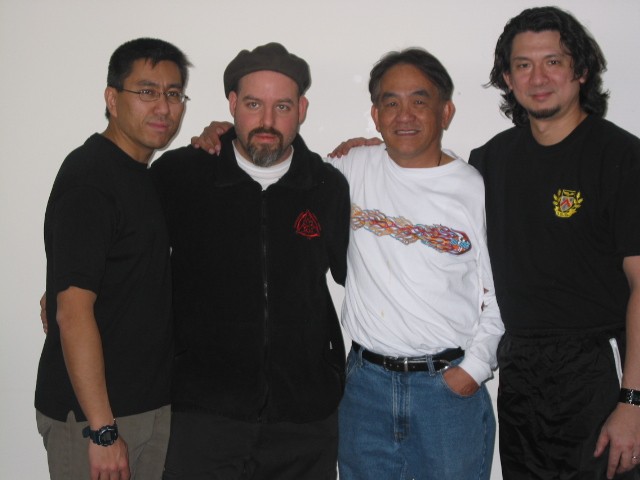
Ka Jay Saludo, Ka Jeff, Tito Jun, Kuya Doug - 02/2006

Sorry for the late update! In early February 2006, the Motor City was host to a monumental international event of epic proportions - the 1st annual Pekiti Tirsia Pitbull Brotherhood Gathering! Four days of intense training, advanced research and development, and solid friendship for the students and teachers of 3 Pekiti Tirsia groups from Detroit, Rochester New York, and Saskatchewan, Canada all under the auspices of Grand Tuhon Leo T. Gaje Jr.

The tone of the weekend was the refinement of Pekiti Tirsia to its highest level. Each instructor presented a unique interpretation of Pekiti knife (Kol Demama Daga, Dagaso Tirsia) and Stick (Contradas) based on his own field studies with Tuhon Gaje. In addition, in keeping with the spirit of "open exchange" each instructor presented a special instructional block of complimentary disciplines:

- Guro Doug Marcaida of Rochester, New York taught a fast and furious knife-fighting module followed by some of the most powerful doble-baston training methods from Kali DeLeon.

- Manong Leon Saludo (aka "Tito Jun") of Saskatchewan presented a bevy of frightening knife applications based on the rare "Vientenueve" knife style of his home province of Batangas.

- Guro Jay Saludo gave an incredible teaching block of HIGHLY UNORTHODOX handgun QCB based on the Batangas style of gunfighting, which addressed carry, draw, target aquisition, and shooting against multile opponents. This was an excellent counter-point to Tuhon Gaje's presentation of the legendary Pekiti Tirsia Gun Seguidas earlier last year. After Guro Jay's portion of the seminar, it was off to the gun range to "field test" some of the principles covered at the seminar, where Detroit Pitbull Damon Mitchell 's outstanding performace with the .40 calibre will be remembered for generations!

- Guro Jeff Davidson introduced the visiting students to some of the finer applications (pecahan) from the Malaysian Art of Silat Kuntau Tekpi, demonstrating SKT's explosive and economical entries, full body locks, and lethal throws.

A full report/photo essay of the weekend events is in preparation along with plans for the next Pitbull family gathering...

Stay Tuned!


Sunday, February 05, 2006

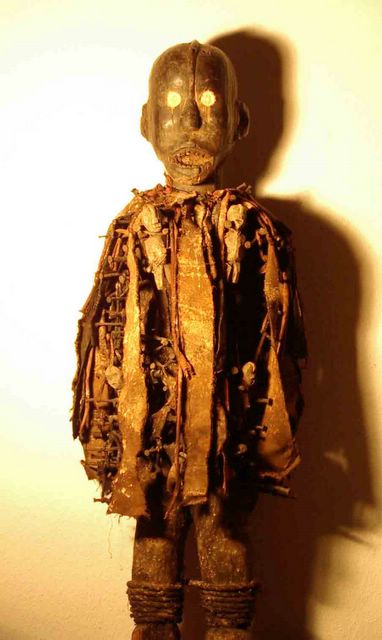
Abre Kutu...


"When the hot blood of the town still left its panting print in the flagstones of the entrance of the Castle of San Severino, the shots of the troops alarmed the population again; in one of their corridors applied the brujos the Law of Flight"
-La Caricatura, Havana

Kongo mio
ven de lo monte
yo te llamo a laborar
cuando venga, ven despacio
paso a paso a trabajar

yo te llamo y tu respondes
yo te llamo de verdad
yo te llamo con tu mbele
yo te llamo pa jugar

yo te veo en la malesa
trabajando material
con tu cazuela de barro
y tu mpaka pa mirar

tu te llamas “Como Quieras”
tu nombre no quieres dar
lo que querio congo mio
no nos dejes de ayudar...

Monday, January 30, 2006

Balisong Tested - Pekiti Approved


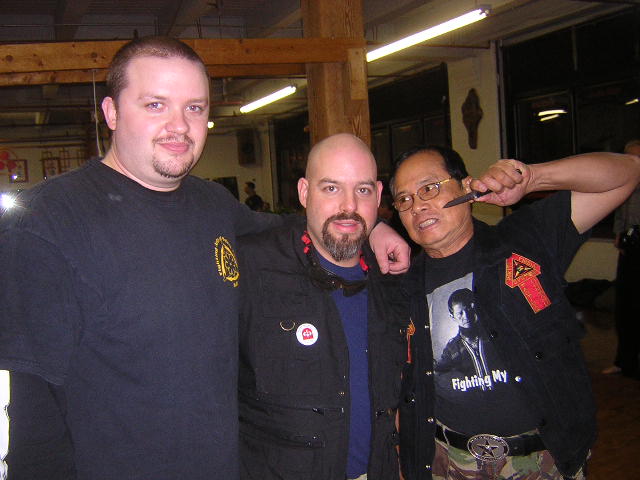
Ungyo Hooks Pitbull Jeff Danuloff's Arm

Congratulations are in order for Ungyo - former US Army Ranger, current SWAT operator, and now certified Assistant Instructor for the Detroit Pekiti Tirsia Pitbulls. Ungyo recently passed the "Live Blade Test" which consists of full-speed knife-tapping against a live blade (in this case a Balisong) wielded by a motivated Senior Instructor.

He passed the test with flying colors (especially the color red). Ungyo now has a few more well-earned battle scars, and the right to proudly wear the tag: "INSPECTED BY #29"

Mabuhay!

Sunday, January 29, 2006

Sask Pitbulls Back Online!


We'll Bring Our Knives to a Gunfight If We Want To!

I'm happy to report that our brothers, the Sask' Pekiti Tirsia Pitbulls are finally back online with a new website:

http://www.pekiti-tirsia.ca/

This photo was taken outside of Target Sports in Royal Oak, Michigan with some of the Sask Pitbulls Dan, Sandra, Eddie, Lucas, and of course Ka Jay Saludo and "Tito Jun". That's Tuhon of course with the rifle; Detroit Pitbull Dean Hadin is providing cover in the back with a hammer-less .357.

Welcome to Detroit!

Wednesday, January 18, 2006

"Hanya Aku Dengan Tuhanku"


There is Always Hope

The Holy Master, we are told, would go into the forest whenever faced with a difficult task. He would light a fire, say a prayer, and what he had set out to perform was done.

In the next generation, his disciple, could no longer remembered how to light the fire, but he did know the place to go and the prayer to utter.

The third generation could neither light the fire nor say the prayer, but it could still find the sacred place in the forest.

All generations since cannot even do that. What then can we, do? We can tell the story of how it was done...

and that will be sufficient.

Terima Kasih, Nadzrin - jd

Friday, January 06, 2006

"Di Luar Jangkauan Pemikiran Kita."


"The Place I Told You Guys About" - Philippines, 02/2005
photo by Jeff Davidson

One day a small boy saw a toy in a store window. He begged and pleaded with his parents to purchase the toy for him, but it was well beyond their simple means. Every evening he began to dream of the toy, and every day he would plead with his parents to purchase him the gift, and every day they said “no”.

This continued on for several days. Eventually, the child stopped pleaded for the toy, for his dreams of the toy had become a suitable replacement. He dreamed of the many wonderful adventures he had with his prized toy, and of the joy it brought to his life. He examined every minute detail.

One morning when he awoke, he discovered the toy sitting at the foot of his bed. Overjoyed, he raced to his parents to express his gratitude. His parents where puzzled, because they had not purchased the toy, and asked the child where he got it. Retreating into his room, the child began to ponder the toy and its origin. He discovered that the toy had come from his dreams, created by his own mind.

Every night he would dream of a different toy, and every morning a new toy would appear at the foot of his bed. Whenever he desired something, he simply dreamt it, and the next morning it would appear.

After several days of this, the child discovered that his gift also worked outside of his dreams. Whenever he wanted something, he simply thought of it, and it magically appeared. Whenever he wanted an event to occur, he thought of the outcome, and that outcome would happen.

One afternoon, several larger boys began to threaten him. The boy dreamt that he wasn’t there, and the walls of reality around him began to collapse, taking him with them.

Wednesday, December 28, 2005

First Tekpi Class of 2006


WHEN: Sunday, January 29, 2006
WHERE: The Training Hall
TIME: 12pm - 3pm

All those who have completed the first 10 buah will need new training cards. Please bring your training journals. Also, BE ON TIME! No one will be permitted to join the class after Senaman Tua begins.

Sunday, December 18, 2005

PTK Mentality / Happy Holidays


Never Drop Your Guard Around Tuhon!

We had a fantastic discussion in class last week, after a beginning student asked me to elaborate on how Pekiti Tirsia tactics apply to a typical violent encounter on the street (as if there is a such thing as a 'typical' violent encounter.) What was clarified in the course of that discussion, is the unique mentality of the Filipino martial artist in his approach to combat.

I had prepared a transcript of sorts from memory of the points we talked about with the intention of publishing them here. However, I first ran it by another student of mine who is a criminal defense attorney - and he advised against it for several reasons. On reflection, it might not be prudent to discuss such sensitive issues as one's personal resolutions on combat in a public forum. Lets just say that I'll follow Ollie North and Dave Chapelle - and plead the 5th.

I have studied FMA since 1987 with various teachers, each having a unique approach to actual combative applications. To someone coming from a radically different orientation, as in the more mainstream martial arts, this is a completely different world, so to speak. Boxers, grapplers, and Karateka have a very well-defined idea of how, when, and why they will apply their respective disciplines. But if you are a FMA practitioner - true to the tradition of your Art - ask yourself exactly WHAT are you training for with those sticks and blades? Why, when, and how will you use it?

Of all those teachers I trained with, none had a mental format of their system quite similar to Tuhon Gaje. Pekiti Tirsia is more than a weapon, a technique, or a characteristic drill or way of moving. Pekiti Tirsia is a mentality. Those practitioners who are considered to be on a particularly high level in this system understand this. This is not something I have seen Tuhon actually teach during lessons, though he may discuss it over coffee afterwards. There is a scene in the movie Hero, where the protagonist explains that he was able to figure out a rival swordsmans "game" by observing the way he did calligraphy. Take a lesson from that. When you watch Tuhon Gaje give several radically different interpretations of a single technique or drill, you can either come away confused...or you can gain some insight into the unique Pekiti Tirsia mentality which powers ALL of our techniques. Think on this! Even a rank beginner can appreciate the level of Tuhon Gaje's technical mastery. But only when you understand the Mind that brings it forth, will you even begin to appreciate Tuhon's true genius. That's all I'll say on that. Are you with me Ungyo?

On another note, I want to send my blessings and best wishes for the New Year to all of our friends, students, teachers, and supporters. This has been without question our greatest year yet. We've made friends across continents, opened new doors, learned a helluva lot, and most importantly come together as the tightest group of comrades-in-arms I have ever had the honor to be associated with. 2006 has every indication of being even better. We have taken this year out with a monsterous bang, and we'll come out hitting full-force next year - God Willing!

God Bless You All!

JD

Tuesday, December 06, 2005

The Rolling Tiger of Banten


Mas Gorka in Banten, West Java

The bonds between Michigan and Biarritz are strong. In the near future, I will be working more closely with the noble Basque warrior Gorka Echarri. I asked him to post a little about his practice on my blog, and it is with pleasure that I reproduce his article here. - JD

My dear brother Jeff asked me to write an article about Cimande...
This really nice offer put me in an odd situation because I've seen in the past that this word "cimande" is the subject of so many wars between schools in the "western part of the world". Anyway, I'll try to share my little knowledge and my personal experience, hoping that it will be able to clear the path of some true seekers.

To start I've to be really clear about the word Cimande. There is a saying in the pencak silat comunity that says that Cimande is like a broken glass. When you drop a glass on the floor there are a hundred pieces of glass on your floor but none of these pieces can say "hey ! I'm THE REAL glass" in truth all of them are the glass. In the same way, Cimande is like the broken glass and each school of Cimande is part of the same art, and none of them can say "hey ! I'm THE Cimande".

So what I would like to share is just a part of Cimande. This part of Cimande is the one I've looked for in the villages of West Java, in the Banten region, in the village of Serang. There, in this village, people are playing Pencak Silat like in France we are playing soccer, I would say that 70 to 80% of the people I've met are playing Pencak Silat.

The Cimande style that I've been taught is called Cimande Macan Guling. Cimande is the name of the style and Macan Guling (Rolling Tiger) is the name of the school. This school is very famous and very well known in Serang. They're under the authority of the PPPSBBI (Persatuan Pendekar Persilatan Seni Budaya Banten Indonesia) a very famous regional organisation. PPPSBBI has got 500 000 Silat players in West Java with 90 different styles. This organisation has been created in 1971 by Pendekar H. Tubagus Chasan Sochid a very famous man with a big charisma and a great influence on Banten region. PPPSBBI has been created to protect and develop all the traditional Pencak Silat styles from Banten (what they are doing is great...). In Cimande Macan Guling we've got jurus (codified movements), Langkahs (codified steps), Kelidans (arms game to develop reflex, hardeing the arms...), Golok (machete) jurus, pisau (knife) jurus, toya (staff) jurus, sarong jurus... Its a very wide style with a lot of material to learn.

Beside this technics knowledge there is 2 rituals very important that are done to accept a new student within the Cimande Macan Guling family. The first one is called Pangurutan or Urut. It's a ritual during the one your arms are beaten hardly by a top teacher (guru dewan) with a ritual oil, a flower bath and prays. This rituals has to be done 7 times. The second ritual is called Keceran it's a ritual that is done once a year during which you receive drops of a sacred water in
your eyes. In Cimande Macan Guling, there are a lot of "great teachers" (guru dewan) and each of them has a speciality (the pangurutan, the kelidans, the jurus...) so when I go there I often train with several teachers and it can give me a large view on this great style. I hope that this short text can help the true seeker to see clearer in the wide world of Cimande

Gorka Echarri - Biarritz - France

Monday, December 05, 2005

Silat Melayu Issue #4 (and Counting!)

I have just received the fourth outstanding issue of the ezine Silat Melayu. I told you guys this was great stuff. To give somewhat of a "peek" into the nature of a few of the topics covered in Silat Melayu, I would like to reproduce here an on-line discussion between Saiful Azraq and myself which took place several months ago (yes Saiful, I have saved every one of them.)

My initial question to him was: "Why is there such a reluctance on the part of Malaysian Silat teachers to show the 'real thing' during demos" Saiful's observation is below in italics:

In the 1940s-1960s, Malaysia was overrun by Judo, Karate and Taekwondo resulting in many Malays looking down upon the low-key, humble Silat. It wasn't until four masters, all brash in their own right and ahead of their time decided to play the karate game and created fancy demonstrations of power and coordination

Cekak did away with the flowery movements and went straight to fast-paced rock em sock em demos and trained just as hard and fast. Gayong incorporated karate-like reverse punching and blocking to standardise the demo movements and so did Lincah

Gayung Fatani although still flowery, sped the movements up and put a guy in front to replace the 'shadow' that was there once and \get beaten. I've seen Gayong demos and they look nothing like what they train in.

Just like Cekak. There are three kinds of Cekak. One for demos (which is flashy and hard), one for training, (which is boring and repetitive) and one for combat, (which is very, very deadly an requires minimal locking)

You have to understand, real silat is nothing to look at. They had to diversify to make it more interesting for youth to identify with. It's nothing to see with a guy standing one second and lying down the next.

My next question was "Why were the Malaysian Silat teachers that Donn Draeger mentioned in his book so secretive?"

Remember this, Malays became a colonised race in 1511 and gained independence in 1957
Many promises were made by the Portuguese, Dutch and English and many more were broken. Trust did not come easily to the Malays when a white man they associated with colonisation was asking them about the one remaining thing they could keep a secret. Nowadays, with a strong background in law and knowing their rights, more silat are willing to open their doors, but learning from the mistakes of the Indonesians.

Anyway, Silat Melayu is probably the best resource out there for the non-Malay Silat enthusiast. Cikgu Nadzrin and his worthy colleagues have answers that we don't even have the questions for...yet. My order stands: Check it out!

Wednesday, November 23, 2005

Be Advised!


Dearborn, Michigan 04/2004

That man with the training knife facing Tuhon Gaje is a certified Bad Ass!

HUUUUUAAAAAH!

Monday, November 21, 2005

Got Keris?


Martin with Empu Jeno


Mas Martin Notohardjo is the President/Curator of Pojok Keris Singobarong (Singobarong Keris Corner) in Central Java. It was by Mas Martin’s kind invitation that I was able to learn about the keris and other Indonesian Pusaka in Central Java in September, 2000.

Martin has an extensive network of contacts all over Indonesia. He can locate and acquire virtually any Indonesian weapon (or variations thereof) in any condition, of any era you can think of - with 100% authentication. In some cases, he can even do keris appraisals via digital photograph. If there is anything at all you need to know about the keris, then this is your man.

If you would like information on purchasing keris, keris appraisal, or even locating reputable Silat teachers in Indonesia, email me and I will be happy to forward your request to Mas Martin.

Just to clear up some mis-understanding that I have seen in print, Pojok Keris Singobarong does NOT sell or give keris/pusaka from any Kraton in Java. I say this because some clown has been known to foist faux Kraton items to other clowns, sourcing it back to PKS. Well, it’s not so.

There’s no Easter Bunny either.

Akiyesi!

Several interested folks have asked me for more information on Ode Remo (see a few postings back) Well, there is a new book called: Orisa - Yoruba Gods and Spiritual Identity in Africa and the Diaspora (isbn 1-59221-374-x) which contains a paper by Kevin Noel Amherd entitled Ifa Texts: Diversity and Discourse - this is positively the best exposition on the history of Ode Remo that I have seen anywhere in print. One of Kevin's informants is John Abiodun Ogunleye, the martial artist I had the friendly match with as detailed in my "Challenge in West Africa" post.

I met Kevin a few years back in Oakland, Ca. While we may have had slightly differing opinions on martial arts, I applaud him for undertaking such a serious, scholarly examination of Ode Remo from a unique perspective.

Ore're!

Sunday, November 20, 2005

NEW SILAT MELAYU E-ZINE!

Hey Everyone!

The emminent Silat scholar/resercher/practitioner Mohd Nadzrin Wahab has published two issues of a brand new Silat e-zine appropriately called SILAT MELAYU. I cannot recommend this work highly enough. It just so happens that the second issue features an outstanding article about a certian Silat Kuntau Tekpi group in the Midwestern United States.

Subscriptions may be ordered by emailing:

silatmelayu@gmail.com

I command you all to subscribe (its free)

Wednesday, November 16, 2005

Senaman Tua

In response to numerous requests from my students for more information on Senaman Tua, I offer the following brief explanation from our friend Saiful Azraq. As anyone who has been put into at least one full-body lock from Cekak or Silat Kuntau Tekpi can attest, it is murder on the joints. I liken Senaman Tua to 'yoga' for the joints. We have been doing it for 7 months, and I have seen remarkable results in my students strength and flexibility.

By way of a personal testimony, in the summer of 2004 I tore the ACL in my right knee during a dumog match. After 3 months of physical therapy I decided not to have surgery, but the knee was obviously not fully functional. I learned Senaman Tua from Omar Hakim in April of 2005, and after a rigorous program of x2 per week for an hour my knee was stronger than it was before the tear - by July!

I recommend either 15 minutes a day, or 1 hour twice per week. Maintain each exercise from 1 to 99 seconds, and remember Nafas Melayu...

Now from Brother Saiful:

SENAMAN TUA literally means Old Exercise but to do it justice, I
prefer to translate it as Sagely Exercise. The word TUA in Malay
commonly means old in English. However, the difference between our
cultures makes miscommunicates the term. TUA comes from the Archaic
Malay/ Sanskrit word TUHA which means Prime. From this word comes
TUHAN (God), TUA (Old), colours like BIRU TUA (Dark Blue), KETUA
(Leader), PENGETUA (Principal) and many others. In the Malay culture,
the old are revered for their wisdom and surpassive knowledge.
Therefore, SENAMAN TUA means the knowledge of human exercises that
have arisen out of hundreds of years of research and development,
experimentation and testing. Each of them bear a deep amount of wisdom
within them.

However, another interpretation of SENAMAN TUA as explained by its
founder guru Azlan Ghanie is that it is a shortening of PETUA which
comes from the Arabic word Fatwa. A fatwa is a conclusive decision or
result of detailed research and development by a master in a
particular field. For example, e=mc2 is a fatwa of Einstein who
reduced the relationship of energy and matter into five symbols.
Therefore, the SENAMAN TUA is bound by a minimum of four PETUA, Nafas
Melayu, Lam Alif, Mata Angin and Jantan Betina. There are more but are
merely extrapolations of the four.

Tuesday, November 15, 2005

NY Seminar


"It's All Fun Until Someone Loses An Eye!"
(Jeff & Doug doing some "Knife-Clowning")

Hosting a public seminar is never an easy task. Co-ordinating 3 seminars in two countries on the same weekend is a feat that most sensible people would not even want to attempt. I am proud to say that my friend, teacher, and mentor Guro Doug Marcaida of Rochester, New York did just that - and flawlessly - this past weekend.

The event began on Thursday afternoon with Guro Doug and Tuhon Gaje presenting a Pekiti Tirsia knife and gun seminar to SWAT groups from all over New York, including Homeland Security. Friday evening featured another well-attended civilian seminar in Rochester by Tuhon Gaje covering double knife and dumog.

On Saturday we were able to spend some quality time training with Guro Doug, literally picking up where we left off almost a year ago since our last Detroit/Rochester group training. Later in the day, it was off to Toronto where we were joined by the incomparable Guro Jun DeLeon in preparation for the final day of instruction on Sunday.

Pekiti Tirsia is experiencing a rebirth of sorts in the United States. Guro Doug is at the forefront of this movement, as it were. He has studied with the greatest of Tuhon's 1st generation students, and his high level of understanding and refinement allows him to distill the very finest wine from the grapes of Tuhon's extensive knowledge.

It was an honor and a privilege for my students and I to share some Silat Kuntau Tekpi with Guro Doug, as well as just to be a part of this outstanding event.

Maraming Salamat
Doug.

Saturday, November 05, 2005

The Players


Maphilindo Demo Squad 11/04/2005

From left: Bassam Hammoud, Dean Hadin, Jamal Hakim Abdullah, Guro Davidson, Jeff Danuloff
Back: Damon Mitchell Darryl Mundrick

GREAT JOB GUYS!

Another Great Demo


Guro Davidson with Hamisi and the Rah African Drumming Ensemble

Our most recent demo took place at the Southfield Civic Center pavillion, and was sponsored by Aloha Tropics. This festival featured a multi-cultural lineup of Indian, Hawaiian , Filipino, and Spanish folkdancing, as well as African Drumming and Filipino martial arts.

The Detroit Maphilindos are grateful to our new friends, The Rah African Drumming Ensemble from Mt. Clemens for providing outstanding live percussion during our set. Now, most drummers in Detroit are so heavily influenced by Cuban modes that even when they try to play traditional African rythmns, it still sound like Salsa. This group was different, however. Their playing was so inspirational and "in the pocket" I literally could not stop moving! Even after our part of the demo had concluded, Hamisi and his group played on, so that I had no choice but to take up a sword and dagger and go where the Spirit led me.

Hamisi is a practitioner of Filipino martial arts himself, and we discovered that we have several friends in common in both the martial arts and percussion scene in Detroit. Small world...eh?

Gentlemen, I say to you "A dupe pupo!" I hope we have the pleasure of performing together again soon.

Ashe!

Wednesday, November 02, 2005

French Cimande Par Excellence


Guru Gorka Echarri with Cimande Masters

My good friend of many years Guru Gorka Echarri of Biarretz, France is the French Director of the Cimande system of Pencak Silat under the auspices of Persatuan Pendekar Persilatan Seni Budaya Banten in West Java.

The Cimande system is one of most prolific, yet misunderstood systems of Pencak Silat from Java. Wild misconceptions about this art abound, especially in the United States. I admire Guru Echarri for taking the initiative to go directly to the source in Indonesia for the Truth. I invite all French speakers to visit his impressive website at

http://www.cimandefrance.com

Gorka is very fluent in English, and I'm sure he would be happy to answer any questions from those seeking knowledge of authentic Cimande and Terumbu as practiced in Indonesia. For the record, let me just say that there is NO "Leader" or "Guru Besar" of all Cimande styles - especially not in the United States. There are various lineages of Cimande from the late Pak Herman Suwanda and others. There is also no single "Superior" or "Legitimate" Cimande style even in Indonesia. Just like any other martial art, there are different interpretations, each with its own merit.

As they say in France, "Vive la diference!"